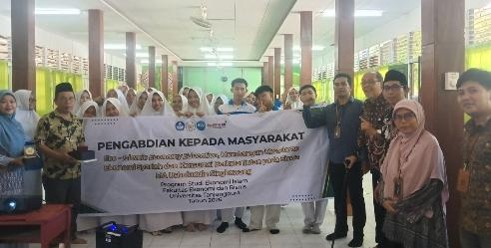
Eco-Islamic Economy Education: Penguatan Literasi Ekonomi Syariah dan Konsumsi Berkelanjutan pada Siswa MA Ushuluddin Singkawang
DOI:
https://doi.org/10.53088/penamas.v6i4.3751Keywords:
Islamic Consumption Ethics, Israf and Tabdzir, Madrasah Students, Sustainable Development, Community ServiceAbstract
Islamic economic literacy among madrasah (Islamic school) students remains low, while their consumption patterns are increasingly influenced by a digital lifestyle that often overlooks environmental sustainability. This community service initiative aimed to enhance students' understanding of Islamic economics and sustainable consumption through an "Eco-Islamic Economy Education" approach. The program was conducted on May 13, 2026, at Madrasah Aliyah Ushuluddin in Singkawang, West Kalimantan, involving 75 students from grades X and XI. The activities included awareness sessions, interactive training, group discussions, and consumption planning simulations. Evaluation was conducted using pre- and post-tests. The results showed an increase in the average score from 52.4 to 78.6—a gain of 26.2 points—with a normalized gain of 0.55, falling into the "medium" category. Observations also indicated active student participation and increased awareness of moderate consumption and environmental responsibility. This approach could be implemented in other madrasahs and Islamic-based schools to strengthen literacy in Islamic economics and sustainable consumption.
References
Abdullah, L. O., Muarief, R., & Kurniawan, Y. D. (2025). Pelatihan literasi investasi berbasis syariah bagi masyarakat muda Kota Madiun: Mewujudkan generasi melek finansial. ARDHI: Jurnal Pengabdian Dalam Negri, 3(5), 176–183. https://doi.org/10.61132/ardhi.v3i5.1583
Abrori, F., Purnami, S., & Ratnasari, D. (2023). Implementasi ice breaking dalam presentasi kelompok terhadap penunjang semangat dan konsentrasi belajar mahasiswa. EDUKATIF: Jurnal Ilmu Pendidikan, 5(5), 2218–2226. https://doi.org/10.31004/edukatif.v5i5.5160
Aldi, S. T., & Supratama, R. (2025). Peran pendidikan agama Islam dalam mengatasi perilaku konsumtif (hedonisme) siswa pada era e-commerce. Jurnal Ar-Ruhul Ilmi: Jurnal Pendidikan dan Pemikiran Islam, 1(3), 50–63. https://risetcendikia.com/index.php/jurnal-arruhul-ilmi/article/view/39
Budiono, I. N., Arifin, A., & Harfiana, F. (2023). Meningkatkan literasi keuangan syariah melalui pelatihan sistem operasional perbankan syariah bagi guru dan siswa UPTD SMAN 5 Parepare. Makkareso: Riset Pengabdian Masyarakat, 1(2), 11–21. https://doi.org/10.35905/makkareso.v1i2.7141
Darnilawati, Nuryanti, & Lubis, H. (2021). Literasi keuangan syariah pada Badan Usaha Milik Desa (BUMDes) se-Kecamatan Tambang, Kabupaten Kampar. Menara Riau: Jurnal Ilmu Pengetahuan dan Pengembangan Masyarakat Islam, 15(2), 66–75. https://doi.org/10.24014/menara.v15i2.13988
Dinc, Y., Cetin, M., Bulut, M., & Jahangir, R. (2021). Islamic financial literacy scale: An amendment in the sphere of contemporary financial literacy. ISRA International Journal of Islamic Finance, 13(2), 251–263. https://doi.org/10.1108/IJIF-07-2020-0156
Diotaiuti, P., Mancone, S., Tosti, B., Corrado, S., Spica, G., & Zanon, A. (2024). Youth, money, and behavior: The impact of financial literacy programs. Frontiers in Education, 9, 1397060. https://doi.org/10.3389/feduc.2024.1397060
Frisancho, V. (2023). Is school-based financial education effective? Immediate and long-lasting impacts on high school students. The Economic Journal, 133(651), 1147–1180. https://doi.org/10.1093/ej/ueac084
Hacıkeleşoğlu, H., Avcı, İ., & Vural, M. E. (2026). The spiritual roots of sustainable consumption among Muslim consumers: Environmental and health consciousness as mediating pathways. Religions, 17(9), 1083. https://doi.org/10.3390/rel17091083
Hake, R. R. (1998). Interactive-engagement versus traditional methods: A six-thousand-student survey of mechanics test data for introductory physics courses. American Journal of Physics, 66(1), 64–74. https://doi.org/10.1119/1.18809
Husamah, Rahardjanto, A., Permana, T. I., & Lestari, N. (2025). Islam and sustainability issues, how far has the relationship progressed? A bibliometric analysis. Social Sciences & Humanities Open, 12, 101703. https://doi.org/10.1016/j.ssaho.2025.101703
Jauhari, M. M., Ahmad, I. P., & Isti'anah, L. (2025). Pendidikan Agama Islam (PAI) untuk membentuk perilaku bertanggung jawab dalam konsumsi dan produksi bagi generasi muda. Jurnal Pendidikan, Kepelatihan, Olahraga, dan Kesehatan (SPORTIKA), 1(2), 155–168. https://doi.org/10.64690/sportika.v1i2.505
Kaiser, T., Lusardi, A., Menkhoff, L., & Urban, C. (2022). Financial education affects financial knowledge and downstream behaviors. Journal of Financial Economics, 145(2), 255–272. https://doi.org/10.1016/j.jfineco.2021.09.022
Kholil, S. (2025). Etika produksi Islami berbasis Maqashid Al-Shariah: Pilar kesejahteraan sosial dan ekonomi. Equality: Journal of Islamic Law, 3(1), 13–25. https://doi.org/10.15575/ejil.v3i1.1220
Koehrsen, J. (2021). Muslims and climate change: How Islam, Muslim organizations, and religious leaders influence climate change perceptions and mitigation activities. WIREs Climate Change, 12(3), e702. https://doi.org/10.1002/wcc.702
Kozanitis, A., & Nenciovici, L. (2023). Effect of active learning versus traditional lecturing on the learning achievement of college students in humanities and social sciences: A meta-analysis. Higher Education, 86(6), 1377–1394. https://doi.org/10.1007/s10734-022-00977-8
Llamosas García, G., & Mazas Pérez-Oleaga, C. (2025). What works in financial education? Experimental evidence on program impact. Journal of Behavioral and Experimental Economics, 119, 102401. https://doi.org/10.1016/j.socec.2025.102401
Lusardi, A., & Mitchell, O. S. (2023). The importance of financial literacy: Opening a new field. Journal of Economic Perspectives, 37(4), 137–154. https://doi.org/10.1257/jep.37.4.137
Maftuh, H., Miftahuddin, M., Saputro, B., & Zaman, B. (2026). Eco-religiopreneurship dalam kurikulum Pondok Pesantren Nuur El Falah. Journal of Instructional and Development Researches, 6(1), 86–101. https://doi.org/10.53621/jider.v6i1.724
Nababan, A. A., Hutabarat, W. B., Simanjuntak, R. P., & Fajri, M. Y. (2025). Strategi pengelolaan sumber daya alam berbasis pembangunan berkelanjutan. Jurnal Pengabdian Masyarakat dan Riset Pendidikan, 4(2), 9334–9339. https://doi.org/10.31004/jerkin.v4i2.3523
Nadhifah, S. N., & Syakur, A. (2025). Etika konsumsi dan tantangan hedonisme perspektif Al-Qur'an dan Hadis. Jesya: Jurnal Ekonomi dan Ekonomi Syariah, 8(1), 557–568. https://doi.org/10.36778/jesya.v8i1.1928
Nisa, D. A., & Putri, N. W. (2025). Analisis perilaku konsumtif remaja terhadap penggunaan ShopeePay ditinjau dari etika konsumsi dalam Islam: Studi kasus pada Desa Pagerbarang. Jurnal Nuansa: Publikasi Ilmu Manajemen dan Ekonomi Syariah, 3(1), 14–27. https://doi.org/10.61132/nuansa.v3i1.1495
Nyrhinen, J., Sirola, A., Koskelainen, T., Munnukka, J., & Wilska, T.-A. (2024). Online antecedents for young consumers' impulse buying behavior. Computers in Human Behavior, 153, 108129. https://doi.org/10.1016/j.chb.2023.108129
Oktayani, D., Ishak, K., Isa, M., Mashuri, M., Ashsubli, M., Dwinanda, G. R., Cahya, A. N., Nabila, S., Galingging, S. H., Norhazlinda, P., & Sutrisno, S. (2024). Peningkatan literasi ekonomi syariah pada siswa Madrasah Aliyah Ar-Rosyidiyah Sungai Alam, Kabupaten Bengkalis. KHIDMAH: Jurnal Pengabdian Kepada Masyarakat, 1(1), 23–26. https://doi.org/10.46367/khidmah.v1i1.1856
Purvis, B., Mao, Y., & Robinson, D. (2019). Three pillars of sustainability: In search of conceptual origins. Sustainability Science, 14(3), 681–695. https://doi.org/10.1007/s11625-018-0627-5
Rahayu, R., Ali, S., Hidayah, R., & Aulia, A. (2024). Examining the role of family and social factors on Islamic financial literacy: Evidence from Indonesia. Journal of Islamic Marketing, 15(9), 2165–2180. https://doi.org/10.1108/JIMA-07-2023-0213
Syed, S., Acquaye, A., Khalfan, M. M., Obuobisa-Darko, T., & Yamoah, F. A. (2024). Decoding sustainable consumption behavior: A systematic review of theories and models and provision of a guidance framework. Resources, Conservation & Recycling Advances, 23, 200232. https://doi.org/10.1016/j.rcradv.2024.200232
van de Wetering, J., Leijten, P., Spitzer, J., & Thomaes, S. (2022). Does environmental education benefit environmental outcomes in children and adolescents? A meta-analysis. Journal of Environmental Psychology, 81, 101782. https://doi.org/10.1016/j.jenvp.2022.101782
Zhang, Q., Husnain, M., Usman, M., Akhtar, M. W., Ali, S., Khan, M. A., Abbas, Q., Ismail, R., Rehman, T., & Akram, M. (2022). Interplay of eco-friendly factors and Islamic religiosity towards recycled package products: A cross-cultural study. Frontiers in Psychology, 13, 840711. https://doi.org/10.3389/fpsyg.2022.840711
Downloads
Published
How to Cite
Issue
Section
License
Copyright (c) 2026 Supriaman Supriaman, Memet Agustiar, Diah Arminingsih, M. Iman Taufik, Faishol Luthfi

This work is licensed under a Creative Commons Attribution-ShareAlike 4.0 International License.
Authors who publish with this journal agree to the following terms:
The author(s) retain copyright and grant the journal the right of first publication with the work simultaneously licensed under a CC BY-SA 4.0 license that allows others to remix, adapt, and build upon the work even for commercial purposes, as long as they credit the author(s) and license their new creations under the identical terms.
License details: https://creativecommons.org/licenses/by-sa/4.0/
Most read articles by the same author(s)
- Supriaman, Memet Agustiar, Faishol Luthfi, M. Iman Taufik, Diah Arminingsih, Pelatihan penguatan ekonomi pesantren melalui pemberdayaan usaha santri di Pondok Pesantren Darul Fikri Kabupaten Kubu Raya , Penamas: Journal of Community Service: Vol. 5 No. 4 (2025): Penamas: Journal of Community Service
- Agil Judistira, Ferdy Zuniansyah, Bayu Dalang Pamungkas, Nungki Kusumatuti, Fransiska Kurniati, Fariastuti Djafar, Supriaman Supriaman, Meningkatkan posisi tawar petani di perbatasan Indonesia - Malaysia , Penamas: Journal of Community Service: Vol. 6 No. 2 (2026): Penamas: Journal of Community Service
- Dea Amanda, Wayan Magdalena, Fauzan Risvi, Celine Dions, Fariastuti Djafar, Supriaman Supriaman, Meningkatkan aktivitas perekonomian warga Di Desa Entikong, perbatasan Indonesia-Malaysia , Penamas: Journal of Community Service: Vol. 6 No. 3 (2026): Penamas: Journal of Community Service


