Penguatan kompetensi digital Guru MI melalui pelatihan pengembangan bahan ajar bahasa arab berbasis Canva
DOI:
https://doi.org/10.53088/penamas.v6i3.3494Keywords:
Teacher Digital Competence, TPACK, Arabic Language Teaching, Canva Education, Participatory Learning and ActionAbstract
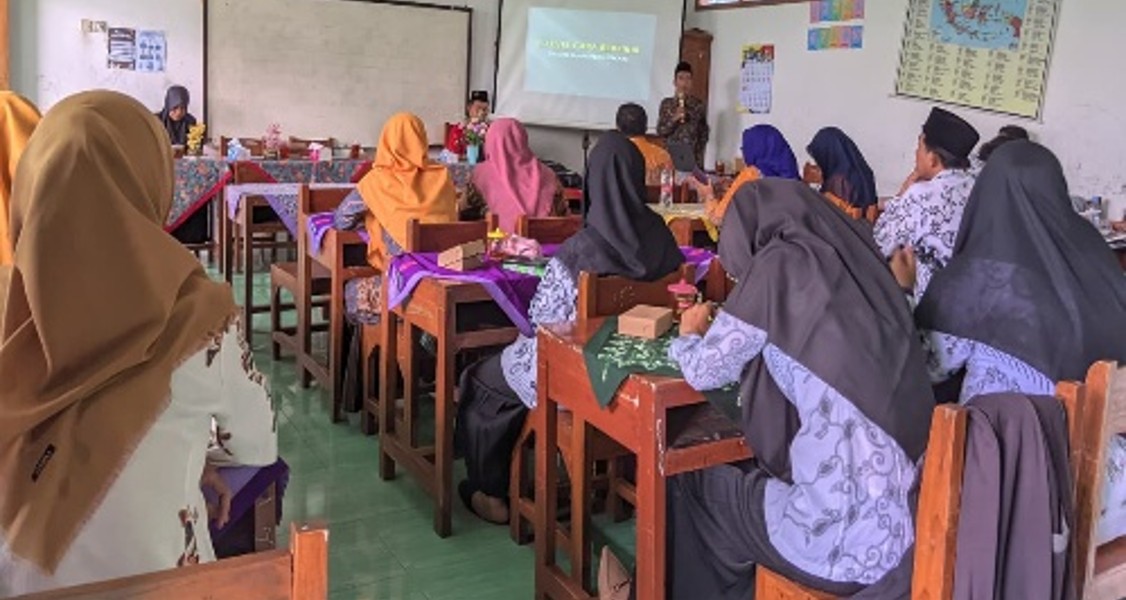
This community service program aimed to strengthen teachers' digital competence, creativity, and capacity to produce classroom-ready digital Arabic teaching materials through Canva-based training. The program applied a Participatory Learning and Action (PLA) approach comprising needs assessment, interactive instruction, demonstration, guided practice, mentoring, product presentation, and evaluation through pre-tests, post-tests, product assessment, and participant-satisfaction questionnaires. Thirty Madrasah Ibtidaiyah Arabic teachers participated. Results showed a significant improvement in participants' average competence scores, from 62.3% (pre-test) to 92.1% (post-test), with a normalized gain (N-gain) of 0.79, categorized as high. All participants produced at least one classroom-ready digital teaching material, including worksheets, vocabulary flashcards, posters, grammar infographics, and interactive presentations. The program's novelty lies in integrating Canva training with Arabic-language material development through an existing teacher professional-learning community, using a complete participatory cycle from needs analysis to product evaluation. Practically, the program offers a replicable, low-cost training model that other madrasah teacher communities can adopt to accelerate digital-pedagogical capacity building without requiring advanced graphic-design skills.
References
Akbar, H. M., & Biyanto. (2022). The Role of Digital Competence for Pre-service Teachers in Higher Education Indonesia. Al-Ishlah: Jurnal Pendidikan, 14(1), 233–240.
Aleman-Saravia, A. C., & Deroncele-Acosta, A. (2021). Technology, Pedagogy and Content (TPACK Framework): Systematic Literature Review. In Proceedings of the XVI Latin American Conference on Learning Technologies (LACLO) (pp. 1–8). https://doi.org/10.1109/LACLO54177.2021.00069
Althubyani, A. R. (2024). Digital Competence of Teachers and the Factors Affecting Their Competence Level: A Nationwide Mixed-Methods Study. Sustainability, 16(7). https://doi.org/10.3390/su16072796
Brianza, E., Schmid, M., Tondeur, J., & Petko, D. (2022). Situating TPACK: A Systematic Literature Review of Context as a Domain of Knowledge. Contemporary Issues in Technology and Teacher Education, 22(4), 707–753.
Chambers, R. (1994). The Origins and Practice of Participatory Rural Appraisal. World Development, 22(7), 953–969. https://doi.org/10.1016/0305-750X(94)90141-4
Fernandes, M. R. J., Widodo, S., Elviani, U., Salsabila, R., Zeng, M., Abdullah, Z., Cheah, K. S. L., Khoerunnisa, I., Fathurochman, A., Althubyani, A. R., Akbar, H. M., & Biyanto. (2025). The Role of Digital Competence for Pre-service Teachers in Higher Education Indonesia. IQRO: Journal of Islamic Education, 16(1), 233–240. https://doi.org/10.3390/su16072796
Heine, S., Krepf, M., & König, J. (2023). Digital Resources as an Aspect of Teacher Professional Digital Competence: One Term, Different Definitions—A Systematic Review. Education and Information Technologies, 28(4), 3711–3738. https://doi.org/10.1007/s10639-022-11321-z
Israilova, D. (2025). Teachers’ Professional Digital Competence in Language Education: A Framework-Based Synthesis. Acta NUUz. https://doi.org/10.69617/nuuz.v1i1.11.1.9818
Kementerian Pendidikan Riset, dan Teknologi, K. (2022). Kurikulum Merdeka: Capaian Pembelajaran. Kemendikbudristek.
Khoerunnisa, I., & Fathurochman, A. (2025). Teachers’ Digital Skills Research Trends: A Scopus Bibliometric Study (2020–2025). IQRO: Journal of Islamic Education. https://doi.org/10.24256/iqro.v8i3.8894
Lestari, N. A., Nurhaliza, N., Hayuningtyas, A. L., & Farahdila, F. (2025). Implementasi Media Pembelajaran Interaktif Menggunakan Aplikasi Canva dalam Proses Pembelajaran di Sekolah Dasar. Jurnal Pengabdian Masyarakat Bangsa, 3(5), 2251–2257. https://doi.org/10.59837/jpmba.v3i5.2694
Mayer, R. E. (2021). Multimedia Learning (3rd ed.). Cambridge University Press. https://doi.org/10.1017/9781316941355
Mishra, P., & Koehler, M. J. (2006). Technological Pedagogical Content Knowledge: A Framework for Teacher Knowledge. Teachers College Record, 108(6), 1017–1054. https://doi.org/10.1111/j.1467-9620.2006.00684.x
Mofid, M., & Sya’bah, B. L. M. (2024). Efektivitas Media Canva dalam Pembelajaran Bahasa Arab Guna Meningkatkan Penguasaan Mufrodat Siswa Kelas VII SMP Sunan Kalijogo 2 Jabung Malang. Muhadasah: Jurnal Pendidikan Bahasa Arab, 6(1 SE-Articles), 98–118. https://doi.org/10.51339/muhad.v6i1.2536
Panjaitan, N. A. S., & Rasyid, H. Al. (2023). Pengembangan Media Pembelajaran Komik Bahasa Arab Berbasis Canva. Journal of Education Research, 4(2), 484–495. https://doi.org/10.37985/jer.v4i2.182
Rahmatullah, A. S., Inanna, & Ampa, A. T. (2020). Media Pembelajaran Audio Visual Berbasis Aplikasi Canva. Jurnal Pendidikan Ekonomi Undiksha, 12(2), 317–327.
Redecker, C. (2017). European Framework for the Digital Competence of Educators: DigCompEdu. Publications Office of the European Union. https://doi.org/10.2760/159770
Resmini, N., Satriani, I., & Rafiqoh, D. (2021). Pelatihan Penggunaan Aplikasi Canva sebagai Media Pembuatan Bahan Ajar bagi Guru Sekolah Dasar. Jurnal Abdimas Pedagogi, 4(2), 120–128.
Sholahudin, S., Nurbayan, Y., & Ali, M. (2025). The Competence of Arabic Language Teachers in the Digital Era: A Study Based on the Technological Pedagogical Content Knowledge (TPACK) Framework. Dinasti International Journal of Education Management and Social Science, 6(3), 2055–2065. https://doi.org/10.38035/dijemss.v6i3.3940
UNESCO. (2019). UNESCO ICT Competency Framework for Teachers (Version 3). UNESCO.
Downloads
Published
How to Cite
Issue
Section
License
Copyright (c) 2026 Nur Sholeh, Dewi Marhama. MA, Isna Assarotim Marpuah

This work is licensed under a Creative Commons Attribution-ShareAlike 4.0 International License.
Authors who publish with this journal agree to the following terms:
The author(s) retain copyright and grant the journal the right of first publication with the work simultaneously licensed under a CC BY-SA 4.0 license that allows others to remix, adapt, and build upon the work even for commercial purposes, as long as they credit the author(s) and license their new creations under the identical terms.
License details: https://creativecommons.org/licenses/by-sa/4.0/


