Sosialisasi mikrobiota mulut dan praktik menyikat gigi melalui video edukasi kesehatan untuk mencegah disbiosis oral pada siswa SMP
DOI:
https://doi.org/10.53088/penamas.v6i2.3267Keywords:
Health Socialization, Oral Microbiota, Tooth Brushing, Middle School Students, Health Education VideosAbstract
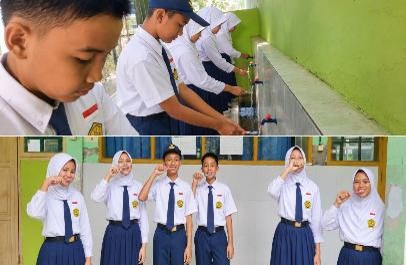
Oral health among junior high school students remains a public health issue in Indonesia. The main problems faced are students' low knowledge of oral microbiota and inadequate toothbrushing techniques. This community service activity aims to improve junior high school students' knowledge and skills regarding oral microbiota and proper toothbrushing techniques. The method used was a one-day community education program held at the UPTD of SMP Negeri 10 Barru, Barru Regency, South Sulawesi, with 40 eighth-grade students participating. The series of activities included a pre-test, a PowerPoint presentation, educational videos on the Fones toothbrushing method, direct toothbrushing practice with assistance, and a post-test. The instruments used were a knowledge questionnaire (15 multiple-choice questions) and a skills observation sheet (7 criteria). The results of this activity showed an increase in students' knowledge and skills in proper toothbrushing. The conclusions from this activity can be recommended for regular implementation in other schools as a structured oral health program.
References
AlHarbi, S. G., Almushayt, A. S., Bamashmous, S., Abujamel, T. S., & Bamashmous, N. O. (2024). The oral microbiome of children in health and disease—a literature review. Frontiers in Oral Health, 5. https://doi.org/10.3389/froh.2024.1477004
Baty, J. J., Stoner, S. N., & Scoffield, J. A. (2022). Oral Commensal Streptococci: Gatekeepers of the Oral Cavity. Journal of Bacteriology, 204(11). https://doi.org/10.1128/jb.00257-22
Chen, C., Hemme, C., Beleno, J., Shi, Z. J., Ning, D., Qin, Y., Tu, Q., Jorgensen, M., He, Z., Wu, L., & Zhou, J. (2018). Oral microbiota of periodontal health and disease and their changes after nonsurgical periodontal therapy. The ISME Journal, 12(5), 1210–1224. https://doi.org/10.1038/s41396-017-0037-1
Corrêa, J. D., Carlos, P. P. S., Faria, G. A., Pacheco, L. C. R., da Costa, V. S., Mendes, I. R. R., de Oliveira, A. B., & Colombo, A. P. V. (2025). The Healthy Oral Microbiome: A Changing Ecosystem throughout the Human Lifespan. Journal of Dental Research, 104(3), 235–242. https://doi.org/10.1177/00220345241297583
Direktorat Jenderal Kesehatan Lanjutan, K. K. R. (2023). Deteksi Dini dan Proteksi Terhadap Karies Gigi Anak. Kementerian Kesehatan R. https://keslan.kemkes.go.id/view_artikel/2976
Gan, G., Chen, R., Zheng, P., Long, K., Cheng, K. K. Y., Sulaiman, J. E., & Huang, X. (2026). Oral pathogens meet the gut microbiome: new mechanistic insights on systemic disease. Frontiers in Cellular and Infection Microbiology, 15. https://doi.org/10.3389/fcimb.2025.1673512
Kementerian Kesehatan RI. (2018). Potret Kesehatan Indonesia dari Riskesdas 2018. Biro Komunikasi dan Pelayanan Masyarakat. https://kemkes.go.id/eng/%20potret-sehat-indonesia-riskesdas-2018
Laiskodat, S. A. (2020). Efektivitas Penyuluhan dengan Video Powerpoint dan Video Rekaman terhadap Tingkat Pengetahuan Tentang Cara Menyikat Gigi. Poltekes Kemenkes Kupang.
Hu, J., Jiang, W., Lin, X., Zhu, H., Zhou, N., Chen, Y., Wu, W., Zhang, D., & Chen, H. (2018). Dental caries status and caries risk factors in students ages 12–14 years in Zhejiang, China. Medical Science Monitor, (24), 3670–3678. https://doi.org/10.12659/MSM.907325
Muthmainnah, & Octavia, O. (2025). Kesehatan Gigi Anak: Memahami Krisis Gigi Anak Lewat Teori Health Belief Model. https://fkm.unair.ac.id/2025/11/17/kesehatan-gigi-anak-memahami-krisis-gigi-anak-lewat-teori-health-belief-model/
Rawati, S., & Sri, J. (2024). Comparing the efficiency of Animation and Leaflet-Based Dental Health Education on Improving Dental Care Behavior in Children. Health Educ Health Promot, 12(3), 443–448.
Rahmi, S. A., Mulia, R. J., Sara, F., & Rahman, W. A. (2023). Penggunaan media yang efektif dalam promosi kesehatan gigi dan mulut pada anak sekolah dasar. JIKES: Jurnal Ilmu Kesehatan, 1(2), 203–209.https://doi.org/10.71456/jik.v1i2.278
Sedghi, L., DiMassa, V., Harrington, A., Lynch, S. V., & Kapila, Y. L. (2021). The oral microbiome: Role of key organisms and complex networks in oral health and disease. Periodontology 2000, 87(1), 107–131. https://doi.org/10.1111/prd.12393
Shaiber, A., Willis, A. D., Delmont, T. O., Roux, S., Chen, L.-X., Schmid, A. C., Yousef, M., Watson, A. R., Lolans, K., Esen, Ö. C., Lee, S. T. M., Downey, N., Morrison, H. G., Dewhirst, F. E., Mark Welch, J. L., & Eren, A. M. (2020). Functional and genetic markers of niche partitioning among enigmatic members of the human oral microbiome. Genome Biology, 21(1), 292. https://doi.org/10.1186/s13059-020-02195-w
Suratri, M., Putranto, R., Pracoyo, N., Andayasari, L., Edwin, V., & Suryati, T. (2022). Dental Caries and Habit of Eating Sweet Foods, Drinking Sweet Drinks, and Brushing Teeth Correctly in the Community Aged 15-64 Years. Health Sci J Indones, 13(1).
Theresia, N., Fetty R, Ester I. S., Aldian Y. (2021). Kesehatan Gigi Sangat Penting untuk Anak Usia sekolah. Jurnal Forum Kesehatan: Media Publikasi Kesehatan Ilmiah. Vol 11(1), p-ISSN: 2087-9105 | e-ISSN: 2715-2464
Wulandari, K. (2021). Penyuluhan Karies Gigi dengan Media Slide pada Siswa Kelas VII SMP Negeri 3 Samarinda. MARTABE: Jurnal Pengabdian Masyarakat, 4(2).
Yulistina, Nurbaya, S., Zainab, & Nirmala. (2025). Efektivitas Edukasi Kesehatan Gigi Berbasis Video Animasi terhadap Keterampilan Menyikat Gigi pada Siswa SD Negeri 2 Carawali Kabupaten Sidenreng Rappang. Media Kesehat Gigi, 24(2). https://ejournal.poltekkes-mks.ac.id/ojs2/index.php/mkg
Yuzar, Y., Aljufri, Sriani, Y., Herawati, N., Lisnayetti, & Alhamda, S. (2023). Hygiene Index Siswa dalam Menyikat Gigi dengan Teknik Kombinasi Vertikal Horizontal dan Fone’s Horizontal. Journal of Oral Health Care, 11(1), 1–7. https://doi.org/10.29238/ohc.v11i1.1764
Downloads
Published
How to Cite
Issue
Section
License
Copyright (c) 2026 Juniati Binti Lukman, Ade Irma, Nur Insani Amir

This work is licensed under a Creative Commons Attribution-ShareAlike 4.0 International License.
Authors who publish with this journal agree to the following terms:
The author(s) retain copyright and grant the journal the right of first publication with the work simultaneously licensed under a CC BY-SA 4.0 license that allows others to remix, adapt, and build upon the work even for commercial purposes, as long as they credit the author(s) and license their new creations under the identical terms.
License details: https://creativecommons.org/licenses/by-sa/4.0/


