Membangun kompetensi menulis ilmiah siswa MA sebagai fondasi literasi akademik di perguruan tinggi
DOI:
https://doi.org/10.53088/penamas.v6i2.3170Keywords:
Academic Literacy, Academic Writing, High School Students, Artificial IntelligenceAbstract
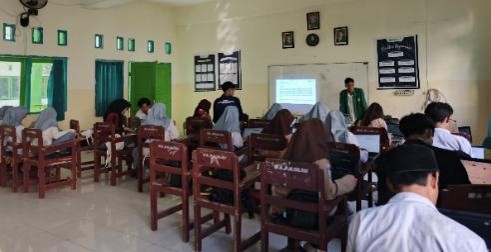
The low level of scientific writing skills among high school students poses a challenge in building academic literacy readiness for college. This community service program aims to improve the scientific writing competencies of students at MA Nurul Islam Plus through outreach, training, technology-based mentoring, as well as evaluation and monitoring. The implementation method uses a participatory approach with a student-centered learning model that positions students as active participants in the learning process. The results of the activities demonstrate an improvement in students’ understanding of the basic structure of scientific papers, idea development, and the more systematic use of academic language. Program evaluation yielded an average response score of 77.29, indicating a positive category. The highest indicator was in the understanding of the use of Artificial Intelligence (AI) in scientific writing, while the lowest indicator was in the IMRAD structure, particularly the results and discussion sections. Although there were variations in ability among students, intensive mentoring was able to gradually improve scientific writing skills. Overall, this program effectively strengthened students’ academic literacy as a foundation for readiness to meet the demands of higher education. Literacy-strengthening programs based on mentoring and digital technology need to be continued on an ongoing basis within the madrasah environment.
References
Anwar, C., Anwar, S., Wasehudin, W., Andriansah, Z., Ananda, R., & Kasturi, R. (2025). Strategi Dan Inovasi Pendidikan Madrasah. STRATEGY: Jurnal Inovasi Strategi Dan Model Pembelajaran, 5(1), 46–57. https://doi.org/10.51878/strategi.v5i1.4975
Dewi, A. C. (2025). Peran Pendekatan Pembelajaran Mendalam dalam Menumbuhkan Keterampilan Menulis Siswa. Journal of Humanities, Social Sciences, and Education, 1(7), 1–10. https://doi.org/10.64690/jhuse.v1i7.309
Fatqurhohman, F., Firdaus, H. P. E., Sujiwo, D. A. C., & Tamami, B. (2025). Pelatihan pemanfaatan teknologi artificial intelligence sebagai strategi penguatan kemampuan menulis karya ilmiah mahasiswa. JUPAMU: Jurnal Pengabdian Masyarakat Multidisiplin, 1(1), 37–48. https://doi.org/10.66031/jupamu.v1i1.28
Geertshuis, S., Wass, R., & Liu, Q. (2024). Equipping graduates with future-ready capabilities: An application of learning theories to higher education. Teaching in Higher Education, 29(5), 1302–1321.
Halawa, R. A. Y., Pardede, N. F., Tambusai, B. A. D., Damanik, F. S., & Purnama, I. (2025). Memahami Teks Akademik: Struktur, Karakteristik, dan Peran Dalam Pengembangan Ilmu. Jurnal Tips Jurnal Riset, Pendidikan Dan Ilmu Sosial, 3(1), 57–70.
Hasan, D. S., & Sangadji, S. S. (2024). Fundamentals in crafting research and community service articles. SCIENTIA: Journal of Multi Disciplinary Science, 3(1), 31-39. https://doi.org/10.62394/scientia.v3i1.102
Hekmah, H., Farid, M., & Rahman, A. (2019). Pemanfaatan media pembelajaran berbasis teknologi dalam meningkatkan literasi akademik siswa. Jurnal Pendidikan Teknologi Dan Kejuruan, 16(2), 145–154. https://doi.org/10.23887/jptk-undiksha.v16i2.18118
Karim, A. R. (2023). Analisis Pentingnya Kemampuan Menulis Karya Ilmiah Pada Siswa Sma. NUSRA: Jurnal Penelitian Dan Ilmu Pendidikan, 4(4), 1226–1233. https://doi.org/10.55681/nusra.v4i4.1802
Kim, C., Preston Jr, K., Braga, A., & Fankhauser, S. C. (2023). Increasing student confidence in writing: Integrating authentic manuscript writing into an Online 8-Week Research Program. Journal of Microbiology & Biology Education, 24(1), e00199-22. https://doi.org/10.1128/jmbe.00199-22
Lebang, R., & Azainil, A. (2025). Kolaboratif Kepemimpinan dan Guru Dalam Pembentukan Sekolah Berkarakter Melalui Literasi Era Digital. Pendas Mahakam: Jurnal Pendidikan Dan Pembelajaran Sekolah Dasar, 10(1), 55–64.
Lubis, M. A. F., Juliani, J., Herawan, B., Sembiring, T. M. B., & Khoir, F. F. (2025). Peran Akreditasi Madrasah dalam Mendorong Inovasi Kebijakan SDM Pendidikan Islam. Mesada: Journal of Innovative Research, 2(2), 1359–1368. https://doi.org/10.61253/55p5ph96
Maryatun, I. B. (2020). Literasi digital dalam meningkatkan kemampuan menulis karya ilmiah mahasiswa. Jurnal Pendidikan Edutama, 7(2), 35–46. https://doi.org/10.30734/jpe.v7i2.819
Maula, N., & Harahap, K. D. (2024). Pembelajaran Science Literacy Di Mtsn 2 Cirebon Melalui Model Authentic Literacy: Investigation Of The Scientific Writing Program At Mtsn 2 Cirebon Through The Authentic Literacy Program. Jurnal Teknodik, 28(1), 29–40. https://doi.org/10.32550/teknodik.vi.1133
Muhtarom, M. (2018). Penerapan pembelajaran aktif dalam meningkatkan kemampuan menulis karya ilmiah mahasiswa. Jurnal Pendidikan Bahasa Dan Sastra Indonesia, 7(1), 45–52. https://doi.org/10.15294/jpbsi.v7i1.29812
Nugraha, M. Y., Ismail, F., & Afgani, M. W. (2025). Inovasi Pengelolaan Budaya dan Iklim Madrasah: Mewujudkan Pendidikan Berkarakter. Indonesian Research Journal on Education, 5(2), 1208–1218. https://doi.org/10.65244/jgge.v2i1.258
Nurkaenah, N., Wahyudin, D., & Sudrajat, A. (2019). Pembelajaran interaktif dan kontekstual dalam meningkatkan kemampuan literasi siswa. Jurnal Pendidikan Dasar, 10(2), 120–129. https://doi.org/10.21009/JPD.010.12
Patty, J. (2025). Pendampingan pengujian karya tulis ilmiah siswa kelas XII SMA kristen YPKPM ambon tahun pelajaran 2024/2025. Development: Journal of Community Engagement, 4(1), 160–168. https://doi.org/10.46773/djce.v4i1.1951
Permana, A., & Fatmawati, F. (2019). Pendampingan penulisan karya ilmiah untuk meningkatkan budaya literasi siswa sekolah menengah. Jurnal ABDINUS: Jurnal Pengabdian Nusantara, 3(2), 198–206. https://doi.org/10.29407/ja.v3i2.13884
Pradana, S. P., Antony, M. K., & Ramadhan, A. N. (2025). Implementasi Pelatihan Menulis Akademik Bagi Mahasiswa: Upaya Meningkatkan Kompetensi Literasi Tulis. Jurnal Kreativitas Dan Inovasi (Jurnal Kreanova), 5(2), 62–69. https://doi.org/10.24034/kreanova.v5i2.7213
Ramaniyar, E., Mulyadi, M., & Hidayat, T. (2019). Pelatihan penulisan karya ilmiah dalam meningkatkan pemahaman sistematika penulisan akademik siswa. GERVASI: Jurnal Pengabdian Kepada Masyarakat, 3(1), 65–74. https://doi.org/10.31571/gervasi.v3i1.1285
Royani, A., Mufidah, V. N., & Harahap, M. (2025). Pendampingan penulisan karya tulis ilmiah untuk meningkatkan kualitas penulisan akademik pada siswa Madrasah Aliyah Khas Kempek. PRAXIS: Jurnal Pengabdian Kepada Masyarakat, 3(3), 51–58. https://doi.org/10.47776/3fxht042
Rumra, M. J. R., Rusmiaty, R., Usman, S., & Ondeng, S. (2025). Madrasah Dalam Pusaran Tantangan Zaman: Upaya Strategis Memperkuat Institusi Pendidikan Islam. Al-Irsyad: Journal of Education Science, 4(2), 447–459. https://doi.org/10.58917/aijes.v4i2.266
Susilo, A., Marianita, M., & Satinem, Y. (2025). Pelatihan dan Pendampingan Penulisan Karya Tulis Ilmiah dan Publikasi untuk Mendorong Peningkatan Kualitas Mahasiswa. Madaniya, 6(2), 813–822. https://doi.org/10.53696/27214834.1230
Trang, N. H., & Barrot, J. S. (2024). Pre-Writing and Post-Writing Explicit instruction: Differential effects on L2 learners’ writing accuracy. RELC Journal, 55(3), 688–704. https://doi.org/10.1177/00336882231184270
Ulviani, M. (2025). Analisis kesulitan siswa dalam menulis cerita naratif di sekolah menengah pertama. Zenodo, 1(2), 17–28. https://doi.org/10.5281/zenodo.17519100
Widyartono, D., & Taufiqurrahman, F. (2025). Kesulitan Guru dalam Mengembangkan Kemampuan Berpikir Kritis Siswa Kelas XI SMA melalui Penulisan Karya Ilmiah. GHANCARAN: Jurnal Pendidikan Bahasa Dan Sastra Indonesia, 7(1), 159–173. https://doi.org/10.19105/ghancaran.v7i1.15909
Downloads
Published
How to Cite
Issue
Section
License
Copyright (c) 2026 Syaharuddin Syaharuddin, Vera Mandailina, Abdillah Abdillah, Mahsup Mahsup, Sirajuddin Sirajuddin, Yunita Septriana Anwar

This work is licensed under a Creative Commons Attribution-ShareAlike 4.0 International License.
Authors who publish with this journal agree to the following terms:
The author(s) retain copyright and grant the journal the right of first publication with the work simultaneously licensed under a CC BY-SA 4.0 license that allows others to remix, adapt, and build upon the work even for commercial purposes, as long as they credit the author(s) and license their new creations under the identical terms.
License details: https://creativecommons.org/licenses/by-sa/4.0/


