From sensory evaluation to operational excellence: A capacity-building program in Tulungagung’s Robusta and Arabica coffee sector
DOI:
https://doi.org/10.53088/penamas.v6i2.3128Keywords:
Operational Excellence, Capacity Building, Coffee, Sensory Evaluation, Barista SkillAbstract
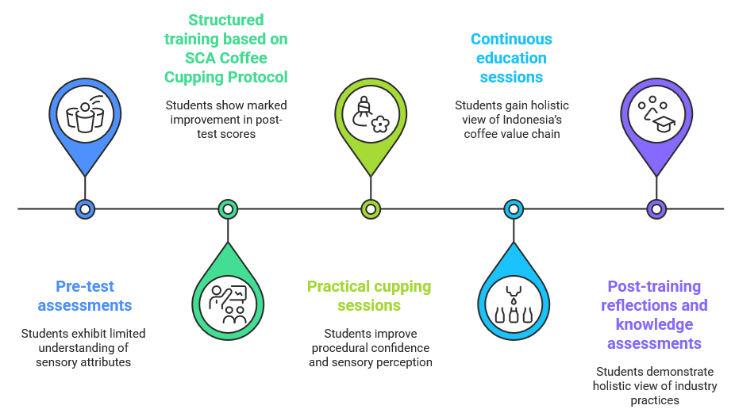
The growing demand for industry-ready human resources in Indonesia’s coffee sector requires vocational students to possess competencies in sensory evaluation and operational coffee skills. This community engagement program aimed to enhance vocational capacity through hedonic–organoleptic assessment and basic barista training among 33 students of the Agricultural Product Quality Control Department at SMKN 1 Tulungagung. The program employed an experiential learning approach integrating training, continuous education, and the Specialty Coffee Association (SCA) cupping protocol. Data were collected using pre-test and post-test assessments, practical observations, and participant feedback. The results demonstrated significant improvements in students’ understanding of sensory attributes, cupping procedures, and coffee operational skills, with increased confidence and competency in evaluating Robusta and Arabica coffee. The program also strengthened participants’ awareness of Indonesia’s coffee industry and vocational readiness. These findings suggest that industry-oriented experiential training effectively supports operational excellence and capacity building in vocational coffee education.
References
Albarico, G. (2024). Exploring education and labor market outcomes: Insights from diverse global contexts. Available at SSRN 5186799.
Bhumiratana, N., Adhikari, K., & Chambers IV, E. (2014). The development of an emotion lexicon for the coffee drinking experience. Food Research International, 61, 83–92. https://doi.org/10.1016/j.foodres.2014.03.008
Chandra, N., Sharma, S. K., & Singh, R. K. (2025). Unveiling intellectual capital efficiency with firm level data: A non-parametric synthesis: N. Chandra et al. Quality & Quantity, 59(2), 1287–1321.
Chernikova, O., Heitzmann, N., Stadler, M., Holzberger, D., Seidel, T., & Fischer, F. (2020). Simulation-Based Learning in Higher Education: A Meta-Analysis. Review of Educational Research, 90(4), 499–541. https://doi.org/10.3102/0034654320933544
Damsbo-Svendsen, M., Menadeva Karpantschof, B.-E., Stovgaard, M., Christensen, J. H., & Frøst, M. B. (2022). Effects on skills and knowledge of a sensory teaching program for culinary students. International Journal of Food Design, 7(2), 119–141. https://doi.org/10.1386/ijfd_00041_1
Eldon, M., & Waskita, G. S. (2025). Compensatory Consumption and Urban Coffee Culture in Indonesia: A Qualitative Exploration of Emotional, Social, and Identity Motives. Synergy in Economic and Business Management, 2(1), 1–17. https://doi.org/10.2222/f6wmdr39
Fania, M., Iriani, T., & Arthur, R. (2024). Improving Vocational Student Competencies Through Industrial Class-Based Experiantial Learning. Jurnal PenSil, 13(1), 120–129. https://doi.org/10.21009/jpensil.v13i1.38151
Fania, M., Iriani, T., & Ramadhan, M. A. (2025). The experiential learning model in productive subjects to enhance students’ industry-oriented skills: A systematic review. Jurnal Inovasi Dan Teknologi Pembelajaran, 63–71. https://doi.org/10.17977/um031v12i22025p063
Howell, R. A. (2021). Engaging students in education for sustainable development: The benefits of active learning, reflective practices and flipped classroom pedagogies. Journal of Cleaner Production, 325, 129318. https://doi.org/10.1016/j.jclepro.2021.129318
Judijanto, L., Ilma, A. F. N., & Waskita, G. S. (2024). Analysis of The Influence of Foreign Direct Investment, Labor Productivity and Technology On Economic Growth. International Journal of Economic Literature, 2(8), 2358–2373.
Mwadzingeni, L., Dandira, M., Kutywayo, D., Mwadzingeni, L., Chiwawa, A., & Simatele, M. D. (2025). Impact of capacity building through learning, training, and coaching on agricultural innovation. Plos One, 20(1), e0314004. https://doi.org/10.1371/journal.pone.0314004
Nogeste, K., & Walker, D. H. (2005). Project outcomes and outputs: Making the intangible tangible. Measuring Business Excellence, 9(4), 55–68. https://doi.org/10.1108/13683040510634844
Obiakor, T., & Newman, K. (2022). Education and employability: The critical role of foundational skills. RISE Insight, 20220, 1–20.
Permani, R., Basir, M. K. H., Winarno, K., Dewan, B., Maryono, M., Dang, T. H., Sarkar, A., Haque, M. M., Muflikh, Y. N., & Krishnasamy, S. (2025). Integrating Agricultural Research into Undergraduate Work Integrated Learning (WIL) Courses. Applied Economics Teaching Resources (AETR), 7(2), 54–72.
Samoggia, A., & Riedel, B. (2018). Coffee consumption and purchasing behavior review: Insights for further research. Appetite, 129, 70–81. https://doi.org/10.1016/j.appet.2018.07.002
Sartono, S., Waskita, G. S., & Isro’iyah, L. (2021). Shadow Economy, Economic Development, and Entrepreneurship. International Seminar, 3, 73–85.
Waskita, G. S. (2025). Sustainable Coffee Ecosystems: Strategic Partnerships for Inclusive and Resilient Supply Chains in Indonesia. Journal of Economics and Banking ESPAS, 2(1), 16–33. https://doi.org/10.28926/espas.v2i1.2209
Waskita, G. S., & Ashari, D. R. W. (2024). Building Competitive Advantage through Management Information Systems: A Managerial Perspective in the Digital Era. ESPAS - Journal of Economics and Banking, 1(1), 1–5. https://doi.org/10.28926/espas.v1i1.800
Waskita, G. S., & Ashari, D. R. W. (2025). Crafting the Perfect Cup: How Sustainable Barista Training Shapes Product Quality at Kedai Kosim, Indonesia. SINDA: Comprehensive Journal of Islamic Social Studies, 5(3), 118–129. https://doi.org/10.28926/sinda.v5i3.2514
Williams, P. J. (2020). Pedagogical Approaches to Vocational Education. In P. J. Williams & D. Barlex (Eds.), Pedagogy for Technology Education in Secondary Schools (pp. 267–282). Springer International Publishing. https://doi.org/10.1007/978-3-030-41548-8_14
Williams, S. D., Barkla, B. J., Rose, T. J., & Liu, L. (2022). Does coffee have terroir and how should it be assessed? Foods, 11(13), 1907.
Yeager, S. E., Batali, M. E., Guinard, J.-X., & Ristenpart, W. D. (2023). Acids in coffee: A review of sensory measurements and meta-analysis of chemical composition. Critical Reviews in Food Science and Nutrition, 63(8), 1010–1036. https://doi.org/10.1080/10408398.2021.1957767
Zizka, L., McGunagle, D. M., & Clark, P. J. (2021). Sustainability in science, technology, engineering and mathematics (STEM) programs: Authentic engagement through a community-based approach. Journal of Cleaner Production, 279, 123715. https://doi.org/10.1016/j.jclepro.2020.123715
Downloads
Published
How to Cite
Issue
Section
License
Copyright (c) 2026 Gautama Sastra Waskita, Nurani, Atina Hidayati, Sutantri, Denny Rakhmad Widi Ashari

This work is licensed under a Creative Commons Attribution-ShareAlike 4.0 International License.
Authors who publish with this journal agree to the following terms:
The author(s) retain copyright and grant the journal the right of first publication with the work simultaneously licensed under a CC BY-SA 4.0 license that allows others to remix, adapt, and build upon the work even for commercial purposes, as long as they credit the author(s) and license their new creations under the identical terms.
License details: https://creativecommons.org/licenses/by-sa/4.0/


