Enhancing young learners' english vocabulary learning with gamified flashcards: A community service at SD St. Theresia Marsudirini 77 Salatiga
DOI:
https://doi.org/10.53088/penamas.v6i2.2929Keywords:
Young Learners, Audio Visual Aids, Vocabulary Learning, GamificationAbstract
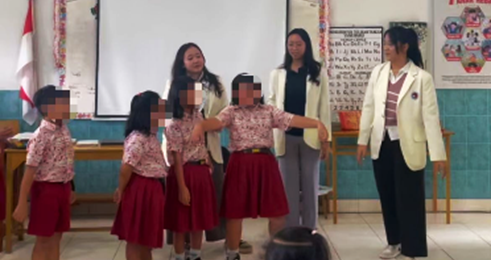
English learning for young learners requires concrete, interactive, and age-appropriate learning materials. The use of gamified flashcards, combined with audiovisual learning, is an effective method. Twenty-eight second-grade students at St. Theresia Marsudirini 77 Elementary School in Salatiga participated in this community service program. The student group conducted classroom observations, interviewed English teachers, and created modified flashcards for the games Act It Out and Fast Four. Results showed that students were enthusiastic, actively participated, and were able to remember and use vocabulary in simple contexts. Teacher feedback confirmed that the flashcards were easy to understand, well-designed, and appropriate for the students' needs. Despite limitations such as the need for simpler instructions for young children, the program demonstrated that creative teaching tools and gamification can make English learning more enjoyable, meaningful, and effective. The program emphasized the importance of using physical visual aids in early English education to support vocabulary development and build children's confidence in communication.
References
Al-aqad, M. H., Al-Saggaf, M. A., & Muthmainnah. (2021). The impact of audio-visual aids in learning English among MSU third-year students. ENGLISH FRANCA : Academic Journal of English Language and Education, 5(2), 201–214. https://doi.org/10.29240/ef.v5i2.3329
Alabi, M. (2024). Visual learning: The power of visual aids and multimedia. ResearchGate, 1–21.
Harmer, J. (2007). The practice of English language teaching (4th ed.). Longman.
Indrayanti, I., Kuntoro, A., & Romadhon, S. A. (2023). Audio-visual aids media, language acquisition and attitude: An initial investigation in the EFL classrooms. LLT Journal: A Journal on Language and Language Teaching, 26(1), 314–323. https://doi.org/10.24071/llt.v26i1.4862
Lo, H., & Wang, T. (2024). A study on the design of embedded visual image teaching aids to assist young children’s cognitive and fine motor development. Journal of Intelligence, 12(102), 1–20. https://doi.org/10.3390/jintelligence12100102
Namaziandost, E., & Nasri, M. (2019). The impact of using audio-visual aids on teaching listening among Iranian pre-intermediate EFL learners. LLT Journal: A Journal on Language and Language Teaching, 22(2), 246–259. https://doi.org/10.24071/llt.2019.220209
Nguyen, T. T., & Pham, H. T. T. (2024). The effectiveness of using visual aids in teaching English vocabulary to Vietnamese young learners: An experimental study. English Education & Applied Linguistics Journal, 7(3), 149–162.
Oladele, O. K. (2024). Kinesthetic learning: Hands-on learning and active engagement. ResearchGate, 1–17.
Putri, F. A. K., Sorohiti, M., & Ariebowo, T. (2023). Teaching English using flashcards to improve elementary school students’ vocabulary. Journal of Foreign Language Teaching and Learning, 8(2), 198–215. https://doi.org/10.18196/ftl.v8i2.21350 Abstract
Syamsiyah, N., & Ma’rifatulloh, S. (2023). The effectiveness of using flashcard to improve students’ vocabulary mastery. JSER: Journal of Science and Education Research, 2(2), 25–30.
Waad, M. A., & Younus, R. Z. (2022). The role of audio visual aids in teaching English. International Journal of Health Sciences, 6(5), 10616–10622. https://doi.org/10.53730/ijhs.v6nS5.10840
Wazeema, T. M. ., & Kareema, M. I. . (2017). Implication of multimedia audio-visual aids in the english language classroom. Proceedings of 7th International Symposium, SEUSL, December, 433–442.
Wulandari, E. M. (2025). The Effectiveness of Using Flashcards on Teaching English Vocabulary. Journal Of English Education and Technology, 05(04), 324–338. https://doi.org/10.59689/jeet.v5i04.58
Wulantari, N. P., Rachman, A., Sari, M. N., Uktolseja, L. J., & Rofi, A. (2023). The role of gamification in English language teaching: A literature review. Journal on Education, 6(1), 2847–2856.
Yilmaz, M. M., Bekirler, A., & Sigirtmac, A. D. (2024). Inspiring an early passion for science: The impact of hands-on activities on children’s motivation. ECNU Review of Education 2024, 7(4), 1033–1053. https://doi.org/10.1177/20965311241265413
Downloads
Published
How to Cite
Issue
Section
License
Copyright (c) 2026 Aubreylia Visca Payungallo, Briana Putri Alridya, Rizky Tri Ardiyani, Sukma Ayu Dwi Setyowati, Yustina Priska Kisnanto

This work is licensed under a Creative Commons Attribution-ShareAlike 4.0 International License.
Authors who publish with this journal agree to the following terms:
The author(s) retain copyright and grant the journal the right of first publication with the work simultaneously licensed under a CC BY-SA 4.0 license that allows others to remix, adapt, and build upon the work even for commercial purposes, as long as they credit the author(s) and license their new creations under the identical terms.
License details: https://creativecommons.org/licenses/by-sa/4.0/


