Strengthening ecological awareness through an Eco-Theology Seminar: A community engagement program
DOI:
https://doi.org/10.53088/penamas.v6i1.2925Keywords:
Eco-Theology, Ecological Awareness, Environmental Stewardship, Theological Education, SustainabilityAbstract
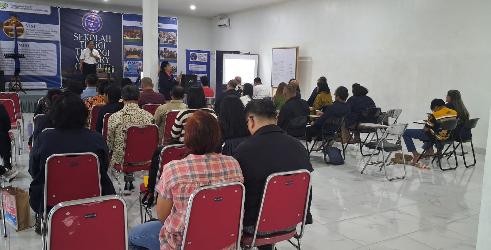
The global ecological crisis has become one of the most pressing challenges facing contemporary societies, including religious communities. However, ecological awareness within many churches and theological institutions remains relatively limited. This community engagement activity aimed to strengthen ecological awareness through an eco-theological educational approach. The program was conducted in the form of a seminar entitled Eco-Theology: Christian Faith and Ecological Responsibility, held at Gedung NOY 153, STT Victory, Cibubur, Indonesia, on 21 February 2026. Participants consisted of church leaders and theology students who are actively involved in theological education and church ministry, with a total of 45 participants involved in the program. The activity employed a participatory educational approach that integrated theological reflection, interactive discussions, and evaluation of participants’ understanding through pre-test and post-test assessments. The results showed a significant improvement in participants’ understanding of the ecological crisis, the biblical foundations of creation care, Christian ecological responsibility, and commitment to environmental stewardship, with an average increase of approximately 46.7% from pre-test to post-test scores. This program demonstrates that eco-theology education can serve as an effective strategy for cultivating ecological awareness and encouraging sustainable practices within theological education and Christian communities.
References
Ardoin, N. M., Bowers, A. W., & Gaillard, E. (2020). Environmental education outcomes for conservation: A systematic review. Biological Conservation, 241, 108224. https://doi.org/https://doi.org/10.1016/j.biocon.2019.108224
Bamberg, S., Rees, J., & Seebauer, S. (2015). Collective climate action: Determinants of participation intention in community-based pro-environmental initiatives. Journal of Environmental Psychology, 43, 155–165. https://doi.org/https://doi.org/10.1016/j.jenvp.2015.06.006
Boff, L. (2002). Cry of the Earth, Cry of the Poor. Orbis Books.
Bringle, R. G., & Hatcher, J. A. (2002). Campus-Community Partnerships: The Terms of Engagement. Partnerships/Community, 23.
Chardin, P. T. de. (1976). The Phenomenon of Man. Harper Perennial Modern Classics.
Conradie, E. M. (2006). Christianity and Ecological Theology: Resouces for futher research. In Study Guides in Religion and Theology 11. Sun Press.
Deane-Drummond, C. (2008). Eco-Theology. Longman and Todd Ltd.
Fink, L. D. (2013). The Current Status of Faculty Development Internationally. International Journal for the Scholarship of Teaching and Learning, 7(2), 1–9.
Jacoby, B. (2014). Service-Learning Essentials: Questions, Answers, and Lessons Learned. Jossey-Bass Publishers.
Jenkins, W., Berry, E., & Kreider, L. B. (2018). Religion and Climate Change. Annual Review of Environment and Resources, 43(Volume 43, 2018), 85–108. https://doi.org/https://doi.org/10.1146/annurev-environ-102017-025855
Johnson, E. A. (2014). Ask the Beasts: Darwin and the God of Love. Bloomsbury Publishing.
Kolb, D. A. (1983). Experiential learning: Experience as the source of learning and development. Prentice Hall.
Landrigan, P. J., Fuller, R., Acosta, N. J. R., Adeyi, O., Arnold, R., Basu, N. (Nil), Baldé, A. B., Bertollini, R., Bose-O’Reilly, S., Boufford, J. I., Breysse, P. N., Chiles, T., Mahidol, C., Coll-Seck, A. M., Cropper, M. L., Fobil, J., Fuster, V., Greenstone, M., Haines, A., … Zhong, M. (2018). The Lancet Commission on pollution and health. The Lancet, 391(10119), 462–512. https://doi.org/10.1016/S0140-6736(17)32345-0
Leddin, D. (2024). The Impact of Climate Change, Pollution, and Biodiversity Loss on Digestive Health and Disease. Gastro Hep Advances, 3(4), 519–534. https://doi.org/10.1016/j.gastha.2024.01.018
Mavisakalyan, A., & Sharma, S. (2020). Religion and Environment. In K. F. Zimmermann (Ed.), Handbook of Labor, Human Resources and Population Economics (pp. 1–26). Springer International Publishing. https://doi.org/10.1007/978-3-319-57365-6_238-1
Monroe, M. C., Plate, R. R., Oxarart, A., Bowers, A., & Chaves, W. A. (2019). Identifying effective climate change education strategies: a systematic review of the research. Environmental Education Research, 25(6), 791–812. https://doi.org/10.1080/13504622.2017.1360842
Moo, D. J., & Moo, J. A. (2018). Creation Care: A Biblical Theology of the Natural World. Zondervan.
Nair, A. K. S., Adamu, Y., Montgomery, H., Kaur, G., Singh, M., Sudharsan, N., & Hang, Y. (2026). Climate Change, Environmental Degradation, and Human Health: A Converging Crisis. Habitable Planet, 2(1), 108–127. https://doi.org/10.63335/j.hp.2026.0029
Otto, S., & Pensini, P. (2017). Nature-based environmental education of children: Environmental knowledge and connectedness to nature, together, are related to ecological behaviour. Global Environmental Change, 47, 88–94. https://doi.org/https://doi.org/10.1016/j.gloenvcha.2017.09.009
Purwanto, E., Jaya, U. P., Kristiawan, S., Tinggi, S., & Injili, T. (2025). Ethical and Theological Responses to Climate Change. Jurnal Luxnos, 11(1), 82–98.
Purwanto, E., & Silalahi, F. H. M. (2024). Christianity and Ecology in Historical and Ethical Contexts. TELEIOS: Jurnal Teologi Dan Pendidikan Agama Kristen, 4(2), 160–171.
Rasmussen, L. L. (2013). Earth-Honoring Faith: Religious Ethics in a New Key. Oxford University Press.
Schaeffer, F. A. (1970). Pollution and the Death of Man. Tyndale House.
Shivanna, K. R. (2022). Climate change and its impact on biodiversity and human welfare. In Proceedings of the Indian National Science Academy. Part A, Physical Sciences (Vol. 88, Issue 2, pp. 160–171). https://doi.org/10.1007/s43538-022-00073-6
Sterling, S. (2016). A Commentary on Education and Sustainable Development Goals. Journal of Education for Sustainable Development, 10(2), 208–213. https://doi.org/10.1177/0973408216661886
Tucker, M. E. (2006). Religion and Ecology: Survey of the Field. In R. S. Gottlieb (Ed.), The Oxford Handbook of Religion and Ecology (p. 0). Oxford University Press. https://doi.org/10.1093/oxfordhb/9780195178722.003.0019
Wamsler, C. (2020). Education for sustainability: Fostering a more conscious society and transformation towards sustainability. International Journal of Sustainability in Higher Education, 21(1), 112–130. https://doi.org/10.1108/IJSHE-04-2019-0152
White, L. (1967). The Historical Roots of Our Ecologic Crisis. Science, 155(3767), 1203–1207.
Whitmee, S., Haines, A., Beyrer, C., Boltz, F., Capon, A. G., de Souza Dias, B. F., Ezeh, A., Frumkin, H., Gong, P., Head, P., Horton, R., Mace, G. M., Marten, R., Myers, S. S., Nishtar, S., Osofsky, S. A., Pattanayak, S. K., Pongsiri, M. J., Romanelli, C., … Yach, D. (2015). Safeguarding human health in the Anthropocene epoch: report of The Rockefeller Foundation–Lancet Commission on planetary health. The Lancet, 386(10007), 1973–2028. https://doi.org/10.1016/S0140-6736(15)60901-1
Downloads
Published
How to Cite
Issue
Section
License
Copyright (c) 2026 Edi Purwanto

This work is licensed under a Creative Commons Attribution-ShareAlike 4.0 International License.
Authors who publish with this journal agree to the following terms:
The author(s) retain copyright and grant the journal the right of first publication with the work simultaneously licensed under a CC BY-SA 4.0 license that allows others to remix, adapt, and build upon the work even for commercial purposes, as long as they credit the author(s) and license their new creations under the identical terms.
License details: https://creativecommons.org/licenses/by-sa/4.0/
Most read articles by the same author(s)
- Keisya Putri Aiko, Siti Nurmalasari, Muhammad Reza, El Pasya Athalla Nadhifa, Amiko Nashita Lumi, Edi Purwanto, Empowering environmental awareness in Kindergarten: A community development initiative on plastic waste management , Penamas: Journal of Community Service: Vol. 4 No. 2 (2024): Penamas: Journal of Community Service
- Edi Purwanto, Enhancing research productivity through bibliometric analysis: A community service training for academics , Penamas: Journal of Community Service: Vol. 5 No. 1 (2025): Penamas: Journal of Community Service


