Empowering EFL teachers to craft dynamic English lessons that align with the Merdeka Curriculum
DOI:
https://doi.org/10.53088/penamas.v6i1.2838Keywords:
Differentiated Instruction, English Lesson, Teacher Professional Development, Emancipated CurriculumAbstract
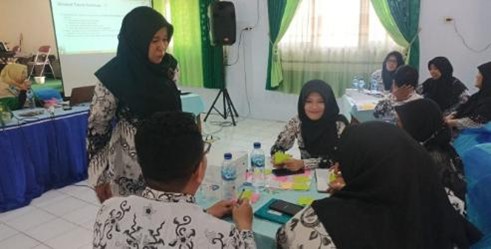
This program aimed to empower EFL teachers to design English lessons that align with the emancipated curriculum. Participatory action research was applied in this study which was conducted at an English teachers' community at junior high level (MGMP) in one of the regencies in Central Java, Indonesia.19 English teachers participated in this program. It covers planning, arrangement, development, and evaluation of the program. Planning was conducted through need analysis by employing a survey and FGD, it was found that classroom differentiation was the major challenge for English teachers in implementing the national curriculum. Thus, a Differentiated Instruction (DI) material for the EFL classroom was designed to be integrated into the program. The workshop materials was arranged by collaborating with an expert and the program developer. Program development was implemented through a one day workshop. A documentation was used to collect the data in the program development. After joining the workshop, one of the English teachers' representatives was interviewed and expressed a positive view of the program.
References
Aulia, R. W. (2021). Teachers ’ perception on the new policy called merdeka belajar ; A page of lesson plan. FIKROTUNA; Jurnal Pendidikan Dan Manajemen Islam, 14(2), 1966–1980.
DeJager, T. (2023). Evaluating effective differentiated instruction in multicultural South African secondary schools. In Effective Teaching Around the World (pp. 691–706). Springer International Publishing.
Firdaus, H., Laensadi, A. M., Matvayodha, G., Siagian, F. N., & Hasanah, I. A. (2022). Analisis evaluasi program kurikulum 2013 dan kurikulum merdeka. Jurnal Pendidikan Dan Konseling, 105(2), 79.
Hidayat, R., Susanto, F., Rahayu, E. M., Nungki, A., Soelistijowati, J. O., P, C. F. I., Inggris, P. B., Pgri, U., & Buana, A. (2022). Kurikulum merdeka: Perkembangan dan perubahan dari waktu ke waktu sesuai dengan tantangan zaman. . II(2), 351–363.
Hollenweger, J. (2011). Teachers’ ability to assess students for teaching and supporting learning. PROSPECTS, 41(3), 445–457. https://doi.org/10.1007/s11125-011-9197-3
Junaidi, A. (2021). Kurikulum merdeka: Ide untuk sekolah-sekolah Indonesia di dunia pasca pandemi. Universitas Mataram, November. https://doi.org/10.13140/RG.2.2.21313.07522
Kusmaryani, R. E., Siregar, J. R., Widjaja, H., & Jatnika, R. (2016). Key factors in teacher professional development. Psychology Forum. Asean Conference 2nd Psychology & Humanity, Malang, Indonesia.
Nafi’ah, J., Faruq, D. J., & Mutmainah, S. (2023). Karakteristik pembelajaran pada kurikulum merdeka di madrasah ibtidaiyah. Auladuna. https://ejournal.uas.ac.id/index.php/auladuna/article/download/1248/591
Nasser, M. K., Nur, M., & Sumarni, M. N. (2024). Kebijakan dan implementasi pembelajaran berdiferensiasi pada kurikulum merdeka yang fleksibel; Apakah memang fleksibel. Jurnal Review Pendidikan dan Pengajaran, 7(1), 855–860.
Nugroho, T., & Narawaty, D. (2022). Kurikulum 2013, kurikulum darurat( 2020-2021 ), dan kurikulum prototipe atau kurikulum merdeka (2022) mata pelajaran bahasa inggris: suatu kajian bandingan. Proceeding Unindra, 1, 373–382.
Rumiati, R., Ayuni, R. P., Wulandari, R., Saputri, S. D., & Monica, T. (2024). Hambatan dan tantangan dalam penerapan kurikulum merdeka terhadap proses pembelajaran di SDN 1 Yogyakarta. Jurnal Pendidikan Guru Sekolah Dasar, 1(3), 7. https://doi.org/10.47134/pgsd.v1i3.272
Septiana, A. R., & Hanafi, M. (2022). Pemantapan kesiapan guru dan pelatihan literasi digital pada implementasi kurikulum merdeka. ULIL ALBAB: Jurnal Ilmiah Multidispin 1(3), 380–385.
Suwastini, N. K. A., Rinawati, N. K. A., Jayantini, I. G. A. S. R., & Dantes, G. R. (2021). Differentiated instruction for EFL classroom. TELL-US Journal, 7(1), 14–41. https://doi.org/10.22202/tus.2021.v7i1.4719
Wiguna, I. K. W., & Tristaningrat, M. A. N. (2022). Langkah mempercepat perkembangan kurikulum merdeka belajar. Edukasi: Jurnal Pendidikan Dasar, 3(1), 17. https://doi.org/10.55115/edukasi.v3i1.2296
Yuli, R. R., Munandar, K., & Salma, I. M. (2023). Keselarasan implementasi pembelajaran berdiferensiasi dengan visi pedagogis ki hajar dewantara dalam mewujudkan merdeka belajar. Jurnal Teknologi Pendidikan, 1(2), 10. https://doi.org/10.47134/jtp.v1i2.80
Downloads
Published
How to Cite
Issue
Section
License
Copyright (c) 2026 Nur Muthmainnah, Firmansyah Bayu Aji Manggala, Azza Musta’anudin

This work is licensed under a Creative Commons Attribution-ShareAlike 4.0 International License.
Authors who publish with this journal agree to the following terms:
The author(s) retain copyright and grant the journal the right of first publication with the work simultaneously licensed under a CC BY-SA 4.0 license that allows others to remix, adapt, and build upon the work even for commercial purposes, as long as they credit the author(s) and license their new creations under the identical terms.
License details: https://creativecommons.org/licenses/by-sa/4.0/


