Remaja visioner: Mengenal investasi dan mengelola keuangan remaja di SMK TAMTAMA 2 Sidareja
DOI:
https://doi.org/10.53088/penamas.v6i1.2754Keywords:
Financial Literacy, Investment, Community Service, Early InvestmentAbstract
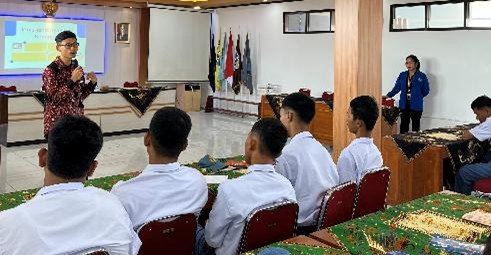
This community service program aimed to enhance students’ financial literacy and understanding of early investment at SMK Tamtama 2 Sidareja. The program was implemented using a participatory and contextual approach that comprised the stages of planning, implementation, and evaluation. The activities were conducted through material delivery, interactive discussions, and simple financial simulations. Program evaluation was conducted using pre- and post-test instruments to measure changes in participants’ understanding. The results indicated an average increase of 34% in students’ knowledge related to financial literacy concepts, pocket money management, and investment awareness. In addition to cognitive improvement, the program fostered students’ awareness of more rational financial behaviour, as reflected in their intentions to save and to control their consumption habits.
References
Ajzen, I. (1991). The theory of planned behavior. Organizational Behavior and Human Decision Processes, 50(2), 179–211. https://doi.org/10.1016/0749-5978(91)90020-T
Alqam, M. A., & Hamshari, Y. M. (2024). The impact of financial literacy on financial inclusion for financial well-being of youth: evidence from Jordan. Discover Sustainability 2024 5:1, 5(1), 528-. https://doi.org/10.1007/s43621-024-00704-6
Fayombo, G. A. (2012). Active Learning: Creating Excitement and Enhancing Learning in a Changing Environment of the 21 st Century. Mediterranean Journal of Social Sciences, 3(16). https://doi.org/10.5901/mjss.2012.v3n16p107
Frisancho, V. (2019). The Impact of Financial Education for Youth. https://doi.org/10.18235/0001791
Jahanian, R., & Darky, R. (2013). Effective Factors on the Self-Efficacy of Educational Managers. International Journal of Academic Research in Business and Social Sciences, 3(12). https://doi.org/10.6007/IJARBSS/V3-I12/414
Jamil, P. C., Yulyanti, S., & Andriani, N. (2023). LITERASI KEUANGAN DAN KEPUTUSAN INVESTASI PADA PRODUK KEUANGAN SYARIAH. Jurnal Tabarru’: Islamic Banking and Finance, 6(1), 155–163. https://doi.org/10.25299/JTB.2023.VOL6(1).13000
Lusardi, A., & Mitchell, O. S. (2012). Implications for Retirement Wellbeing of Financial Literacy and Planning. SSRN Electronic Journal. https://doi.org/10.2139/SSRN.1695146
Mancone, S., Tosti, B., Corrado, S., Spica, G., Zanon, A., & Diotaiuti, P. (2024). Youth, money, and behavior: the impact of financial literacy programs. Frontiers in Education, 9, 1397060. https://doi.org/10.3389/feduc.2024.1397060
Moore, D. L. (2003, December). Survey of Financial Literacy in Washington State: Knowledge, behavior, Attitudes, and Experiences. Social and Economic Sciences Research Center, Washington State University. https://doi.org/10.13140/2.1.4729.4722
OECD. (2014). Financial Education for Youth THE ROLE OF SCHOOLS. OECD Publishing. https://doi.org/10.1787/9789264174825-en
OJK. (2025, May 2). Siaran Pers Bersama: Indeks Literasi dan Inklusi Keuangan Masyarakat Meningkat, OJK dan BPS Umumkan Hasil Survei Nasional Literasi Dan Inklusi Keuangan (SNLIK) Tahun 2025. Ojk.Go.Id. https://ojk.go.id/id/berita-dan-kegiatan/siaran-pers/Pages/OJK-dan-BPS-Umumkan-Hasil-Survei-Nasional-Literasi-Dan-Inklusi-Keuangan-SNLIK-Tahun-2025.aspx
Peiris, T. U. I. (2021). Effect of Financial Literacy on Individual Savings Behavior; the Mediation Role of Intention to Saving. European Journal of Business and Management Research, 6(5), 94–99. https://doi.org/10.24018/EJBMR.2021.6.5.1064
Remund, D. L. (2010). Financial literacy explicated: The case for a clearer definition in an increasingly complex economy. Journal of Consumer Affairs, 44(2), 276–295. https://doi.org/10.1111/J.1745-6606.2010.01169.X;WGROUP:STRING:PUBLICATION
Santrock, J. W. (2018). Adolescence (17th ed.). McGraw-Hill Education. https://books.google.com/books/about/Adolescence.html?id=4ZQ10AEACAAJ
Zhu, A. Y. F. (2020). Impact of Financial Education on Adolescent Financial Capability: Evidence from a Pilot Randomized Experiment. Child Indicators Research, 13(4), 1371–1386. https://doi.org/10.1007/s12187-019-09704-9
Downloads
Published
How to Cite
Issue
Section
License
Copyright (c) 2026 Gawik Setiawan, Andhi Johan Suzana, Dian Safitri Pantja Koesoemasari

This work is licensed under a Creative Commons Attribution-ShareAlike 4.0 International License.
Authors who publish with this journal agree to the following terms:
The author(s) retain copyright and grant the journal the right of first publication with the work simultaneously licensed under a CC BY-SA 4.0 license that allows others to remix, adapt, and build upon the work even for commercial purposes, as long as they credit the author(s) and license their new creations under the identical terms.
License details: https://creativecommons.org/licenses/by-sa/4.0/
Similar Articles
- Joe Valentino Gosal, Joshua Wijaya, Clarence Yosia, Nanik Linawati, Meningkatkan kesadaran finansial generasi muda melalui pelatihan literasi keuangan di sekolah menengah atas , Penamas: Journal of Community Service: Vol. 5 No. 2 (2025): Penamas: Journal of Community Service
- Jessica Lorita Harijanto, Louis Nichollas Saputra, Grecia Jeslyn Ezar, Nanik Linawati, Menanamkan literasi keuangan dan investasi pada remaja melalui game-based learning: Rally Games , Penamas: Journal of Community Service: Vol. 4 No. 2 (2024): Penamas: Journal of Community Service
You may also start an advanced similarity search for this article.


