Pembelajaran bahasa inggris berbasis permainan edukatif untuk penguasaan kosakata things in the classroom pada siswa sekolah dasar
DOI:
https://doi.org/10.53088/penamas.v6i2.2642Keywords:
Educational Games, Game-Based Learning, English VocabularyAbstract
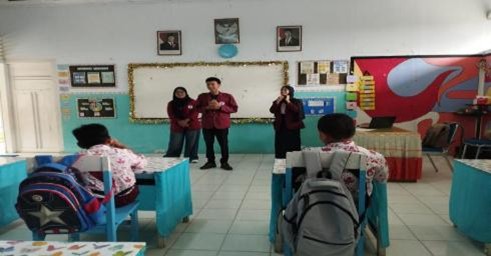
The mastery of English vocabulary from the elementary school level serves as an important foundation for the development of learners’ future language skills. However, English language instruction in elementary schools often faces challenges, particularly low student learning motivation and limited variation in teaching methods. This community service activity aimed to introduce English language learning through educational games using the topic Things in the Classroom for fourth-grade students at SDN 12 Kota Barat. The activity was conducted on December 9, 2025, involving eight students and implemented through the preparation, implementation, and evaluation stages. The instructional approach employed was educational game-based English learning (game-based learning), which was implemented through a contextual vocabulary introduction strategy and learning techniques in the form of Simon Says and song with movement activities using simple rhythmic chants. The results indicated that the game-based learning approach created an active and enjoyable learning atmosphere, increased student engagement, and supported the meaningful acquisition of basic English vocabulary. In addition to its positive impact on students, the activity also provided pedagogical experience for university students and inspired creative teaching practices among classroom teachers. Therefore, educational game-based English learning has the potential to be sustainably implemented in elementary school instruction.
References
Alotaibi, M. S. (2024). Meta-analysis, Game-based learning in early childhood education: a systematic review and. Frontiers in Psychology, 15. https://doi.org/10.3389/fpsyg.2024.1307881
Arvendha, V., Ilyas, R. A. T., Elmaghfiroh, S., Nuraini, R. D., Putra, D. H. A., & Susilawati, S. A. (2026). Implementasi game edukasi ZYLAND berbasis computational thinking untuk meningkatkan literasi numerasi siswa slow learner. Penamas: Journal of Community Service, 6(107–119). https://doi.org/10.53088/penamas.v6i1.2824
Brewster, J., Ellis, G., & Girard, D. (1992). The primary English teacher’s guide. Penguin Books. Penguin.
Cameron, L. (2001). Teaching languages to young learners. Cambridge University Press.
Cameron, L. (2010). Teaching languages to young learners. Cambridge University.
Chowdhury, M., Dixon, L., Kuo, L.-J., Donaldson, J. P., Eslami, Z., Viruru, R., & Luo, W. (2024). Digital game-based language learning for vocabulary development. Computers and Education Open, 6(100160). https://doi.org/10.1016/j.caeo.2024.100160
Hung, H.-T., Yang, J. C., Hwang, G.-J., Chu, H.-C., & Wang, C.-C. (2018). A scoping review of research on digital game-based language learning. Computers & Education, 126, 89–104. https://doi.org/10.1016/j.compedu.2018.07.001
Mohamed, A. M. A. (2021). The impact of educational games on enhancing elementary stage students’ acquisition and retention of English vocabulary. Journal of World Englishes and Educational Practices, 3(2), 67–76. https://doi.org/10.32996/jweep.2021.3.2.6
Sari, D. P., & Lestaria, E. (2023). Using Games to Learn English for Young Learners in Darussalam Elementary school. EDUJ : English Education Journal, 1(1), 15–21. https://doi.org/10.59966/eduj.v1i1.468
Syamsiyah, B., & Jundi, F. Al. (2026). Pelatihan menulis arab menggunakan media kartu bergambar untuk meningkatkan kosakata dan keterampilan menulis siswa MI. Penamas: Journal of Community Service, 6(1), 293–302. https://doi.org/10.53088/penamas.v6i1.2963
Downloads
Published
How to Cite
Issue
Section
License
Copyright (c) 2026 Helena Badu, Rasuna Rasid Talib

This work is licensed under a Creative Commons Attribution-ShareAlike 4.0 International License.
Authors who publish with this journal agree to the following terms:
The author(s) retain copyright and grant the journal the right of first publication with the work simultaneously licensed under a CC BY-SA 4.0 license that allows others to remix, adapt, and build upon the work even for commercial purposes, as long as they credit the author(s) and license their new creations under the identical terms.
License details: https://creativecommons.org/licenses/by-sa/4.0/


