Pengelolaan bank sampah melalui Simbah (Sistem Informasi Bank Sampah) guna meningkatkan akuntabilitas dan transparansi
DOI:
https://doi.org/10.53088/penamas.v5i4.2303Keywords:
Waste, Waste Bank, Information System, Accountability, TransparencyAbstract
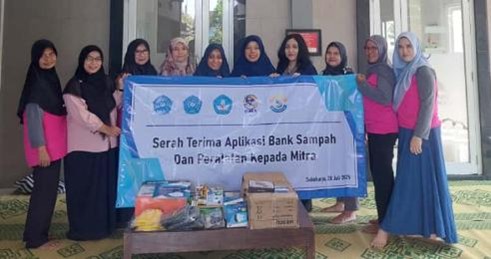
The purpose of this community service activity is to improve the accountability and transparency of the Pagar Idum waste bank. This increase in accountability and transparency is through the Simbah application (waste bank information system). The method for implementing this community service activity starts with surveys and interviews on partner problems, socialization of accountability and transparency, and training on the use of the Simbah application. The participants in this activity were 60 active members of the waste bank. The results of this activity showed that partners experienced a 40% increase in understanding of accountability and transparency (before the activity, 45%; after the activity, 85%). Based on observations during the training on the Simbah application, 80% of partners were able to use it, although some participants still experienced difficulties.
References
Adiyanto, O., Mohamad, E., & Abd Razak, J. (2022). Systematic review of plastic waste as eco-friendly aggregate for sustainable construction. International Journal of Sustainable Construction Engineering and Technology, 13(2), 243-257.
Afdhal, A. (2024). Peran bank sampah dalam memperkuat ekonomi lokal dan membangun lingkungan berkelanjutan. Saskara: Indonesian Journal of Society Studies, 4(1), 134-154. https://doi.org/10.21009/Saskara.041.03
Andayani, N., Mulatsari, E., Moordiani, M., Khairani, S., & Swandiny, G. F. (2022). Edukasi dan Aplikasi Pengelolaan Sampah Berbasis Pemilahan Sampah di Lingkungan Fakultas Farmasi Universitas Pancasila. Jurnal Abdimas BSI: Jurnal Pengabdian Kepada Masyarakat, 5(1), 23-35.
Dahar, R., Rahmi, F., Yanti, N. S. P., & Maharani, K. S. (2023). Penggunaan Aplikasi Akuntansi Bagi Asosiasi Bank Sampah Kota Padang. Prosiding Konferensi Nasional Pengabdian Kepada Masyarakat dan Corporate Social Responsibility (PKM-CSR), 6, 1-8. https://doi.org/10.37695/pkmcsr.v6i0.2159
Dhokhikah, Y., Trihadiningrum, Y., & Sunaryo, S. (2015). Community participation in household solid waste reduction in Surabaya, Indonesia. Resources, Conservation and Recycling, 102, 153-162. https://doi.org/10.1016/j.resconrec.2015.06.013
Fithri, D. L., Setiawan, R., Nugraha, F., & Latifah, N. (2024). Pengelolaan Bank Sampah Muria Berseri berbasis Digital Desa Gondangmanis Kabupaten Kudus. ABDINE: Jurnal Pengabdian Masyarakat, 4(1), 51-58. https://doi.org/10.52072/abdine.v4i1.825
Hidayat, R., & Fredy, M. (2023). Optimalisasi Kinerja Pengurus Bank Sampah Desa Bening melalui Pelatihan dan Pengembangan Sistem Kerja yang Terstruktur. Prosiding Patriot Mengabdi, 2(01), 167-177.
Muanifah S, Cahyani Y. Pengelolaan Bank Sampah Dalam Menumbuhkan Peluang Usaha Nasabah Bank Sampah. Sci J Reflect Econ Accounting, Manag Bus. 2021;4(1):150–9. https://doi.org/10.37481/sjr.v4i1.258
Pravasanti YA, Ningsih S. Bank Sampah Untuk Peningkatan Pendapatan Ibu Rumah Tangga. Budimas J Pengabdi Masy. 2020;2(1):31–5.
Renwarin, J. M., Hendayana, Y., Lucky, A. N., Lestari, A. S., & Saputro, F. H. (2024). Mengurangi Dampak Ekologis dengan Metode Reduce, Reuse dan Recycle; Pembinaan Dini terhadap Anak-Anak Pusat Jagaan Darul Sakinah Selangor Malaysia. Jurnal Abdimas Adpi Sosial dan Humaniora, 5(2), 72-79. https://doi.org/10.47841/jsoshum.v5i2.403
Sari, Y., Hidayati, N., & Sumandar, S. (2023). Zero Waste Lifestyle Guna Mencapai Lingkungan Bebas Sampah dengan Menerapkan Prinsip 3R (Reduce, Reuse, Recycle). Jurnal Kreativitas Pengabdian Kepada Masyarakat (PKM), 6(5), 1740-1749. https://doi.org/10.33024/jkpm.v6i5.9118
Selomo, M., Birawida, A. B., Mallongi, A., & Muammar, M. (2016). Bank sampah sebagai salah satu solusi penanganan sampah di Kota Makassar. Media Kesehatan Masyarakat Indonesia, 12(4), 232-240. https://doi.org/10.30597/mkmi.v12i4.1543
Syafer, E., & Putera, R. E. (2024). Analisa Partisipasi Masyarakat dalam Pengelolaan Sampah di Kota Payakumbuh. Innovative: Journal Of Social Science Research, 4(5), 4568-4583. https://doi.org/10.31004/innovative.v4i5.14893
Widiatmoko, S. A., Zahra, A. T., & Permana, K. N. (2024). Penerapan Konsep Zero Waste Dalam Perspektif Hukum Lingkungan: Tantangan dan Prospek Masa Depan di Indonesia. Hukum Inovatif: Jurnal Ilmu Hukum Sosial Dan Humaniora, 1(3), 307-320. https://doi.org/10.62383/humif.v1i3.390
Wulandari, F., & Sugiana, K. (2014). Evaluasi prospek keberlanjutan pengelolaan sampah di bank sampah studi kasus bank sampah di kota makassar. Universitas Gadjah Mada.
Zeinora, Z., & Septariani, D. (2020). Analisis Kelebihan Dan Kekurangan Serta Kebermanfaatan Menggunakan Software Accurate, Myob, Zahir Accounting Dan Penerapannya di Universitas Indraprasta PGRI. JABE (Journal of Applied Business and Economic), 6(4), 341–353. https://doi.org/10.30998/jabe.v6i4.4969
Downloads
Published
How to Cite
Issue
Section
License
Copyright (c) 2025 Desy Nur Pratiwi, Yuwita Ariessa Pravasanti, Maya Widyana Dewi, Asadduluh Asadduluh, Ike Gustiani

This work is licensed under a Creative Commons Attribution-ShareAlike 4.0 International License.
Authors who publish with this journal agree to the following terms:
The author(s) retain copyright and grant the journal the right of first publication with the work simultaneously licensed under a CC BY-SA 4.0 license that allows others to remix, adapt, and build upon the work even for commercial purposes, as long as they credit the author(s) and license their new creations under the identical terms.
License details: https://creativecommons.org/licenses/by-sa/4.0/
Most read articles by the same author(s)
- Yuwita Ariessa Pravasanti, Desy Nur Pratiwi, Si Islam Siarno, Yudi Siyamto, Menuju keluarga mandiri dan sejahtera dengan pemahaman keuangan keluarga berbasis syariah , Penamas: Journal of Community Service: Vol. 5 No. 3 (2025): Penamas: Journal of Community Service


