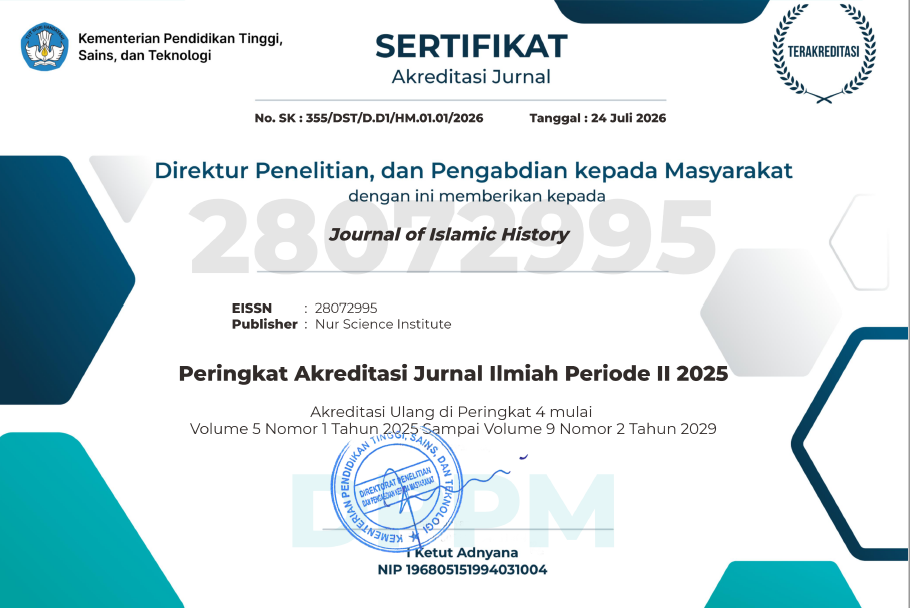
Islamizing Time in Seventeenth-Century Java: Calendrical Reform, Contested Histories, and the Negotiation of Authority
DOI:
https://doi.org/10.53088/jih.v6i1sp.3743Keywords:
authority, historiography, javanese islamic calendar, sultan agung, religious temporalityAbstract
This article investigates the Islamization of time in seventeenth-century Java by reading the calendar reform. This article examines the historical relationship between calendrical knowledge, religious legitimacy, and royal authority. The study employs a critical literature-based historical approach, comparing published analyses of the reform, studies of the Serat Widya Pradhana, and scholarship on Islamic Mataram. It argues that the calendar's combination of a lunar reckoning, inherited year numbering, and Javanese temporal cycles can be interpreted as a negotiated arrangement rather than a total cultural replacement. Attributing calendrical authorship to Sultan Agung and, later, to Sunan Giri II in a literary genealogy indicates competing modes of authorizing Islamic time. These accounts should not be conflated with contemporary evidence for the reform. The article proposes calendrical authority as a limited analytical framework linking knowledge, institutions, and social practice, while acknowledging that the absence of independently examined seventeenth-century manuscripts prevents claims about a uniform implementation throughout Java.
REFERENCES
Adam, B. (1990). Time and social theory. Polity Press.
Adhellia, S. D. F. (2025). Utilization of the Javanese Islamic calendar system for determining auspicious days: A case study of wedding traditions in Jombang, East Java. Al-Hisab: Journal of Islamic Astronomy. https://jurnal.umsu.ac.id/index.php/alhisab/article/view/21792
Aveni, A. F. (2002). Empires of time: Calendars, clocks, and cultures (Rev. ed.). University Press of Colorado.
Fikrah, A. Z. (2024). Implementasi kalender Jawa Islam di Keraton Kasunanan Surakarta Hadiningrat [Tesis magister, Universitas Islam Negeri Walisongo Semarang]. https://eprints.walisongo.ac.id/id/eprint/29616/
Florida, N. K. (1995). Writing the past, inscribing the future: History as prophecy in colonial Java. Duke University Press. https://doi.org/10.1215/9780822378662
Mahmudah, Y. N., & Izzuddin, A. (2023). Kalender Jawa Islam menurut Ronggowasito dalam Serat Widya Pradhana. Al-Afaq: Jurnal Ilmu Falak dan Astronomi, 5(1). https://doi.org/10.20414/afaq.v5i1.6937
Musonnif, A. (2016). Politik hukum dalam perumusan kalender Islam (Studi tentang kebijakan kalender Nabi Muhammad SAW di Jazirah Arab dan kalender Sultan Agung di tanah Jawa). Ahkam: Jurnal Hukum Islam, 4(1), 1–22. https://doi.org/10.21274/ahkam.2016.4.1.1-22
Musonnif, A. (2017). Genealogi kalender Islam Jawa menurut Ronggo Warsito: Sebuah komentar atas sejarah kalender dalam Serat Widya Pradhana. Kontemplasi: Jurnal Ilmu-Ilmu Ushuluddin, 5(2), 329–355. https://doi.org/10.21274/kontem.2017.5.2.329-355
Pigeaud, T. G. T. (1967). Literature of Java: Catalogue raisonné of Javanese manuscripts in the library of the University of Leiden and other public collections in the Netherlands (Vol. 1). Martinus Nijhoff.
Pigeaud, T. G. T., & de Graaf, H. J. (1976). Islamic states in Java 1500–1700: Eight Dutch books and articles by Dr. H. J. de Graaf. Martinus Nijhoff. https://doi.org/10.1007/978-94-015-7187-6
Ramadhan, R., Izzuddin, A., & Mahsun. (2023). Aboge sebagai siklus awal tahun menyalahi sunnatullah. Al-Afaq: Jurnal Ilmu Falak dan Astronomi, 5(1). https://doi.org/10.20414/afaq.v5i1.7003
Ricklefs, M. C. (1998). Islamising Java: The long shadow of Sultan Agung. Archipel, 56(1), 469–482. https://doi.org/10.3406/arch.1998.3503
Ricklefs, M. C. (2006). Mystic synthesis in Java: A history of Islamization from the fourteenth to the early nineteenth centuries. EastBridge.
Ricklefs, M. C. (2008). A history of modern Indonesia since c. 1200 (4th ed.). Stanford University Press.
Ricklefs, M. C. (2014). Rediscovering Islam in Javanese history. Studia Islamika, 21(3), 397–418. https://doi.org/10.15408/sdi.v21i3.1216
Sholehuddin, M., & Qulub, S. T. (2022). Analisis kesesuaian kalender Jawa Islam dengan kalender Hijriyah. Al-Afaq: Jurnal Ilmu Falak dan Astronomi, 4(1). https://doi.org/10.20414/afaq.v4i1.4198
Zerubavel, E. (1981). Hidden rhythms: Schedules and calendars in social life. University of Chicago Press.
Downloads
Published
How to Cite
Issue
Section
License
Copyright (c) 2026 Fairuz Sabiq, Mahira Arrosyida

This work is licensed under a Creative Commons Attribution-ShareAlike 4.0 International License.
Authors who publish with this journal agree to the following terms:
The author(s) retain copyright and grant the journal the right of first publication with the work simultaneously licensed under a CC BY-SA 4.0 license that allows others to remix, adapt, and build upon the work even for commercial purposes, as long as they credit the author(s) and license their new creations under the identical terms.
License details: https://creativecommons.org/licenses/by-sa/4.0/