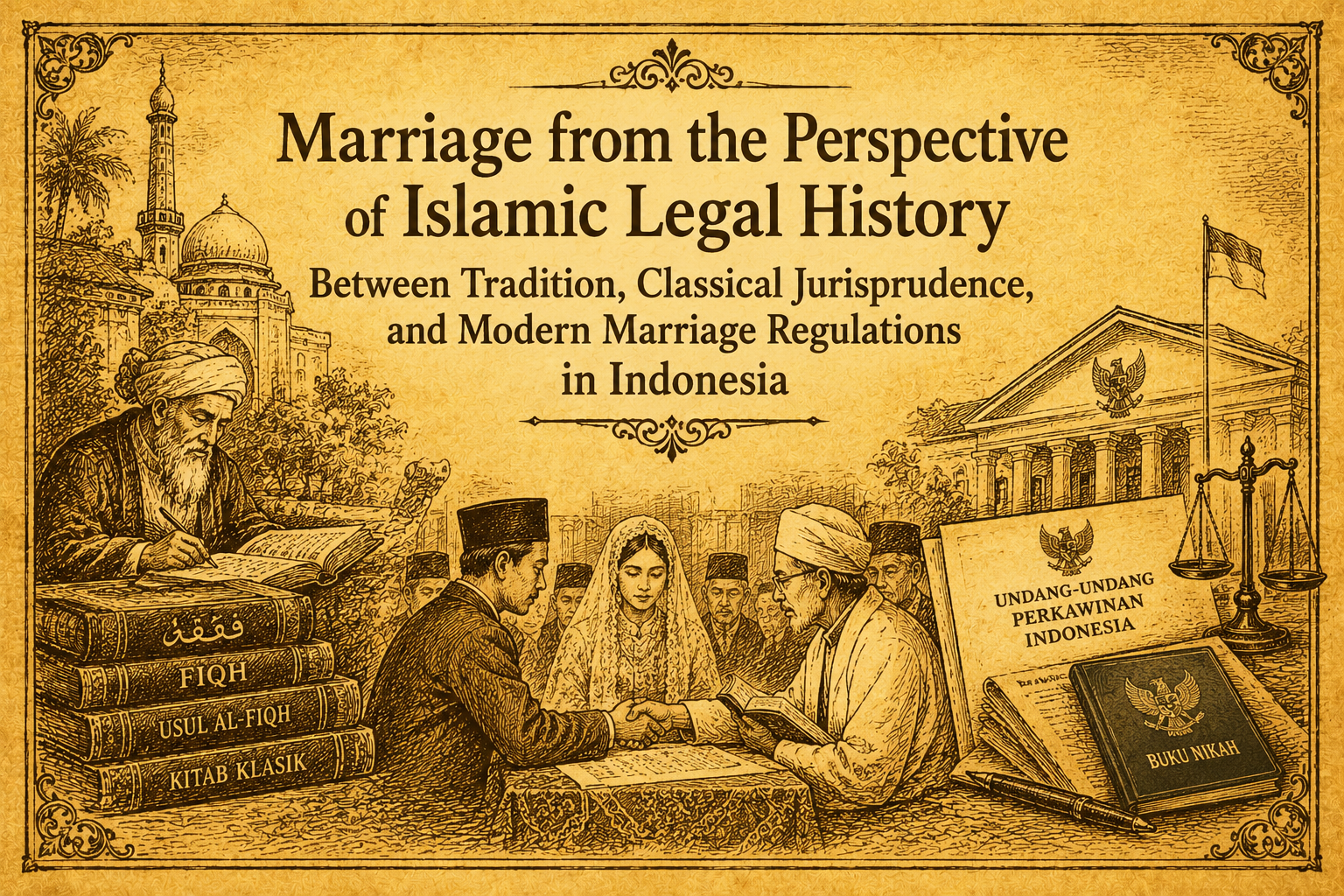
Marriage from the Perspective of Islamic Legal History Between Tradition, Classical Jurisprudence, and Modern Marriage Regulations
DOI:
https://doi.org/10.53088/jih.v6i1sp.3726Keywords:
classical fiqh, history of islamic law, tradition, marriage regulationsAbstract
This article aims to analyze marriage from the perspective of Islamic legal history by examining the interplay between societal traditions, classical fiqh (Islamic jurisprudence) constructs, and modern marriage regulations. Existing research has largely examined marriage traditions, fiqh, or legislation in isolation, failing to historically elucidate how these three elements interacted, negotiated, and underwent transformation in the shaping of Islamic marriage law in Indonesia. The study employs a normative-juridical method, utilizing historical and conceptual approaches. Data were gathered through a literature review of Islamic legal sources, classical fiqh texts, historical works, and contemporary marriage regulations. The findings indicate that marriage practices within Muslim societies have been shaped by the dynamic interaction between normative Islamic teachings and local traditions. Classical fiqh subsequently established legal frameworks influenced by the social, cultural, and political contexts of the era. In modern times, the state has intervened to regulate marriage through codification and legislation, taking into account principles such as public interest (maslahah), the protection of rights, legal certainty, and social change. This article contributes to the historiography of Islamic law by demonstrating that the modernization of marriage law in Indonesia represents a historical transformation process that does not sever ties with the fiqh tradition but rather negotiates it through principles of public interest, rights protection, and legal certainty. Thus, the evolution of Islamic marriage law is not static; rather, it has undergone a process of adaptation transitioning from tradition and classical fiqh thought toward modern regulatory frameworks. A historical analysis of this process is crucial for understanding that Islamic marriage law possesses a contextual dimension, allowing for reform while remaining grounded in the fundamental principles of Sharia.
REFERENCES
AL-Bree, H., & Al-Azzam, S. (2021). Marriage in Pre- Islamic Arabia Its Governing Laws, Ceremonies and Rituals: "A Historical Study". Jordan Journal for History and Archaeology, 9(1). Retrieved from https://archives.ju.edu.jo/index.php/jjha/article/view/10361
Azizah, Laila, and Anwar Hafidzi. (2025). “Harmonization Of National Legal Rights Within The Framework Of Sharia An Customary Law In Indoesia.” IJMR : International Journal Of Multicisplinary Reseach 01(05):429–40.
Chandra, Alicia Arta, and Ni Putu Ayu Darmayanti. (2026). “The Transormation Of Engagement Practices Pinang Meminang In Malaya Marriage : An Islamic Family Law Perspective In Anambas Islands.” Jurnal Ilamiah Ahwal Syakhshiyyah 8(2):58–66.
Chrismac, Faren, Faren Chrismac, Susi Susilawati, and Rosnani Lakunna. (2026). “The Influence of Religious Law on Customary Marriage Practices in South Kulawi.” Teraju : Jurnal Syariah Dan Hukum 8(1):13–22.
Dalimunthe, Dermina, U. I. N. Sekh, Ali Hasan, Ahmad Addary, Nasruddin Khalil Harahap, U. I. N. Sekh, Ali Hasan, Ahmad Addary, Sawaluddin Siregar, U. I. N. Sekh, Ali Hasan, and Ahmad Addary. (2026). “The Relevance of Marriage Regulation In The Indonesian Civil Code to The Development of National Marriage Law.” Sahaja: Journal Sharia and Humanities 5(1):27–37. https://ejournal.darunnajah.ac.id/index.php/sahaja%0AThe.
Harman, Jumni Nelli, and Azni. (2021). “Hukum Perkawinan Islam Di Indonesia.” Ijtihad: Jurnal Hukum Dan Ekonomi Islam 15:1–192.
Ilyas, Afrizal Fadhila, Roykhatun Nikmah, and Diana Zuhroh. (2025). “Transformation of Marriage Will Announcement: Digitalization and Accessibility of Marriage Services in Indonesia.” Proceeding of ICCoLaSS: International Collaboration Conference on Law, Sharia and Society 1(1):303–12.
Juliansyahzen, Muhammad Iqbal. (2020). “Pemikiran Quraish Shihab Di Bidang Hukum Keluarga Islam Di Indonesia.” Istinbath: Jurnal Hukum 18:51.
Latifah, L., and N. Huda. (2026). “Islamic Educational Values in the Baantaran Jujuran Tradition in Banjar Community Weddings.” AL GHAZALI: Jurnal Pendidikan Dan Pemikiran Islam 6(2):689–703. https://jurnal.staialjami.ac.id/index.php/AL_GHAZALI/article/view/527%0Ahttps://jurnal.staialjami.ac.id/index.php/AL_GHAZALI/article/download/527/231.
Mudassir, Fathullah Rusly, and Irzalk Yuliandry Nugroho. (2024). “Analis Sosiologis Pernikahan Islam: Antara Norma Agama Dan Perubahan Sosial.” JMaqasid : Jurnal Studi Hukum Islam 13(2):269.
Muhaimin, Abdul Wahab Abd. (2012). “Implementation Issues with the 1974 Marriage Law and the 1991 Compilation of Islamic Laws.” Ahkam: Jurnal Ilmu Syariah 12(2):11–16.
Mustangin, Muhammad. (2025). “Elements of Islamic Law in Traditional Banjar Marriage ‘Jujuran’ Viewed from a Historical Perspective.” ICILf 261–79.
Noferiadin, Noferiadin, and Reza Okva Marwendi. (2024). “The Dynamics of Marriage Law in Islam: Between Tradition and State Regulations.” Zabags International Journal of Islamic Studies 1(2):59–65. doi:10.61233/zijis.v1i2.10.
Pratama, Finsa Adhi, Ahmadi Lincoln, and James Faikar. (2026). “Negotiating Customary Practices and Islamic Normativity : A Maq Āṣ Id Al-Shariah Analysis of Banten Javanese Marriage Rituals.” 11(1):363–73.
Purnama, Handika. (2021). “Perkawina Islam, Adat Dan Hukum Negara Dalam Perkawinan Masyarakat Suku Melayu Di Pekanbaru Riau Keabsahan , Etika , Dan Administrasi Perkawinan.” Al-Aḥwāl 14(1):1–10.
Ramelan, Irfan Fahmi, and Diah Pudjiastuti. (2025). “Transformation of Islamic Family Law in Indonesia: Fiqh and Law.” International Journal of New Approaches to Law and Rationality in Nationhood, Governance, and Rights Advocacy Nalarnagara 1:600–612.
Rohman, Moh Mujibur, Nuri Wahda, Salsabila Usmany, Syamsul Bahri, and Andi Nur. (2026). “Islamic Family Law Reform in Indonesia ( Typology, Revitalization, and Constitutional Challenges ).” Qisthosia: Jurnal Syariah & Hukum 7(1):85–102.
Rosihah, Rosihah, Abdul Raffi Ardiyanto, Fitria Adzuhri Mahyudin, and Humaeroh Humaeroh. (2026). “A Legal-Normative Analysis of Marriage Registration in Indonesia from the Perspectives of Islamic Law and Positive Law, and Its Implications for the Legal Protection of the Family.” Journal of Human Interaction and Social Studies 1(2):160–69. doi:10.65310/wb7qvy52.
Sari, Widya, and Muhammad Arif. (2025). “Registration of Marriage in Positive Law: Analysis of Justice for Women and Islamic Jurisprudence (Fiqh).” Madania: Jurnal Kajian Keislaman 29(2):259. doi:10.29300/madania.v29i2.9027.
Sodiq, Muhammad. (2016). “Dualisme Hukum Di Indonesia : : Kajian Tentang Peraturan Pencatatan Nikah Dalam Perundang-Undangan.” Al-Ahwal: Jurnal Hukum Keluarga Islam 7(2):109–20. doi:10.14421/ahwal.2014.07201.
Sriharini, Ahmad Izudin, Agus Suprianto, Abrori, and Mohammad Ridwan. (2026). “From Doctrinal Legitimacy to Child Protection: Mapping and Reconstructing Child Marriage Fiqh Studies in Indonesia.” Journal of Islamic Law 7(1):57–83. doi:10.24260/jil.v7i1.5678.
Sugiyono. (2022). Metode Penelitian : Kuantitatif, Kualitatif, Dan R&D. Cet.27. Bandung: Alfabeta.
Umaaya, Rifai. (2026). “‘ Urf Sebagai Jembatan Normatif Antara Hukum Adat Dan Hukum Islam Dalam Perkawinan Muslim Indonesia.” Sangaji 10(1):165–78.
Wirastri, Theresia Dyah, and Stijn Cornelis van Huis. (2024). “The State of Indonesia’s Marriage Law: 50 Years of Statutory and Judicial Reforms.” Ahkam: Jurnal Ilmu Syariah 24(2):215–32. doi:10.15408/ajis.v24i2.38424.
Undang-Undang Nomor 1 Tahun 1974 tentang Perkawinan
Undang-Undang Nomor 16 Tahun 2019 Perubahan atas Undang-undang Nomor 1 Tahun 1974 tentang Perkawinan
Downloads
Published
How to Cite
Issue
Section
License
Copyright (c) 2026 Afrizal Fadhila Ilyas, Achmad Zulfa Al Abid

This work is licensed under a Creative Commons Attribution-ShareAlike 4.0 International License.
Authors who publish with this journal agree to the following terms:
The author(s) retain copyright and grant the journal the right of first publication with the work simultaneously licensed under a CC BY-SA 4.0 license that allows others to remix, adapt, and build upon the work even for commercial purposes, as long as they credit the author(s) and license their new creations under the identical terms.
License details: https://creativecommons.org/licenses/by-sa/4.0/