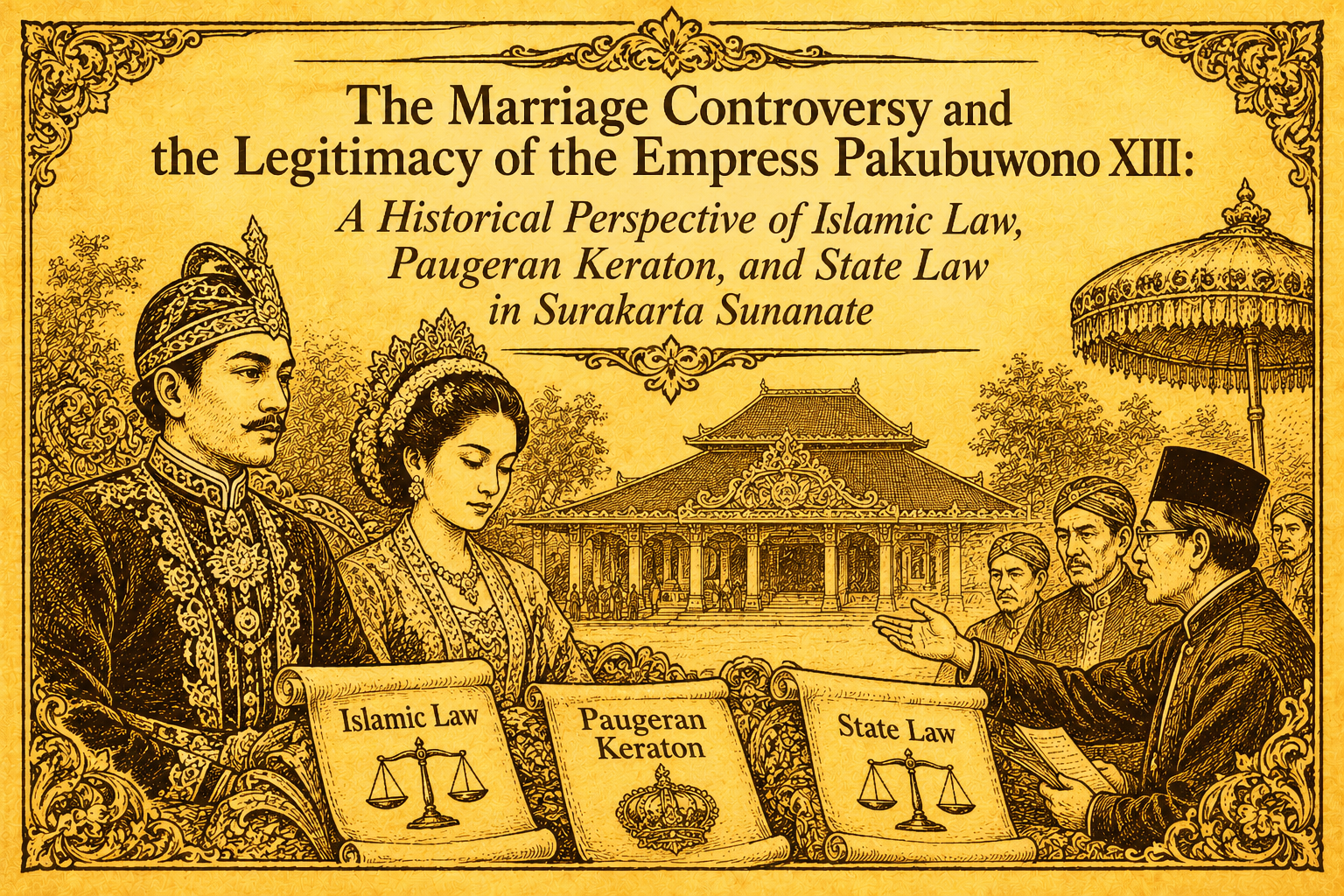
The Marriage Controversy and the Legitimacy of the Empress Pakubuwono XIII: A Historical Perspective of Islamic Law, Paugeran Keraton, and State Law in Surakarta Sunanate
DOI:
https://doi.org/10.53088/jih.v6i1sp.3725Keywords:
consort, islamic marriage, palace statutes, pakubuwono xiiiAbstract
Marriage within the Surakarta Sunanate encompasses religious, legal, customary, and dynastic dimensions that have evolved alongside changes in Indonesia's legal system. This complexity is evident in the controversies surrounding the status of Asih Winarni as the consort of SISKS Pakubuwono XIII and the appointment of KGPH Purbaya as crown prince. Previous studies on marriages within the Surakarta Palace family have tended to focus on customary marriage practices and processions from the perspective of Islamic law; however, the historical evolution and the interrelationships between marriage, palace statutes (paugeran), the legitimacy of the consort, and royal succession have not been comprehensively examined. This article analyzes the controversies regarding marriage and the consort's legitimacy during the reign of SISKS Pakubuwono XIII, examining them through the lenses of Islamic legal history, palace statutes, and state law. The study employs a historical method comprising heuristics, source criticism, interpretation, and historiography. Primary sources include marriage legislation, the Compilation of Islamic Law, documents and literature concerning Surakarta Palace traditions and statutes, and contemporary reports regarding the consort and the crown prince. The findings indicate that the validity of a marriage under Islamic and state law does not automatically confer legitimacy upon the consort or the crown prince within the palace hierarchy. This article contributes to the study of Islamic family law by analyzing the interplay between religious law, state law, custom, and dynastic legitimacy within the context of the Surakarta Sunanate.
REFERENCES
Abdul Karim, M. K. F. R. (2022). The Acculturation Dynamics of the Sekaten Tradition in Modern Indonesia. Dialog, 45, 29–35.
Achmad Hariri, B. B. (2024). LEGAL PLURALISM: CONCEPT, THEORETICAL DIALECTICS, AND ITS EXISTENCE IN INDONESIA.6(2),146–170. https://doi.org/10.21580/walrev.2024.6.2.25566
Agus Triyanta. (2020). Penghulu Pasca Keluarnya Staatsblad 1937 No 116 Kasunanan Surakarta Tahun 1937-1940 M Agus Triyanta Abstrak Pendahuluan Penghulu adalah petugas keagamaan yang melaksanakan upacara pernikahan secara Islam . Istalah penghulu memilik berapa istilah bahasa di. 01(116), 51–67.
Akbar, A., & Laman, I. (2025). Legal Pluralism in the Institution of Marriage : The Intersection of National Law , Islamic Law , and Customary Law in Regulating Marriage and Common Property in North Toraja Indonesia is a country with diverse cultures , religions , and legal systems rec. 06(2), 382–401. https://doi.org/10.24252/shautuna.v6i2.57865
Anggraeni, R. D. (2023). Islamic Law and Customary Law in Contemporary Legal Pluralism in Indonesia: Tension and Constraints. AHKAM Jurnal Ilmu Syariah, 23, 25–48.
Aris Wasita. (2022). Konflik Keraton Surakarta merembet ke penetapan putra mahkota. ANTARA JATENG.
Arps, B. (2019). The power of the heart that blazes in the world: An Islamic theory of religions in early modern Java. Indonesia and the Malay World, 47(139), 308–334. https://doi.org/10.1080/13639811.2019.1654217
Backerra, C. (2024). Source criticism for cultural history. Rethinking History, 28(2), 194–216. https://doi.org/10.1080/13642529.2024.2361214
Carey, P. (1997). Civilization on Loan: The Making of an Upstart Polity: Mataram and its Successors, 1600–1830. Modern Asian Studies, 31(3), 711–734. https://doi.org/DOI: 10.1017/S0026749X00017121
Fadilah, N., & Ismayawati, A. (2024). Pathet Gunem Tradition in Javanese Wedding from the Perspective of Islamic Law. 15, 279–292.
IF Bambang Sulistyono, A. Purwasito, Warto, T. P. (2022). Study of Symbol for the Kasunanan Surakarta Palace through the Spradley Ethnography Approach. IDEALOGY JOURNAL, 7(1), 25--30.
Isnanto, B. A. (2022). Dewan Adat Pertanyakan Keabsahan Pengangkatan Permaisuri Keraton Solo. Detik.Com Jateng.
Karim, A., & Raya, M. K. F. (2022). The Acculturation Dynamics of the Sekaten Tradition in Modern Indonesia. Dialog, 45(1), 29–40. https://doi.org/10.47655/dialog.v45i1.510
Khoirunisa, N., Azizah, N., Kusuma, V. A., Falaq, Y., Ips, T., & Kudus, I. (2024). IDENTITAS SUKU JAWA. Jurnal Ilmiah Arsitektur, 14(2).
Kipping, M., Wadhwani, R. D., & Bucheli, M. (2013). Analyzing and Interpreting Historical Sources: A Basic Methodology. In M. Bucheli & R. D. Wadhwani (Eds.), Organizations in Time: History, Theory, Methods (p. 0). Oxford University Press. https://doi.org/10.1093/acprof:oso/9780199646890.003.0013
Madinier, R. (2023). From “mystic synthesis” to “Jesuit plot”: The Society of Jesus and the making of religious policy in Indonesia. Modern Asian Studies, 57(2), 409–434. https://doi.org/10.1017/S0026749X21000731
Maida, N. H., & M. Muslich KS. (2022). Analisis ageman basahan manten keraton surakarta hadiningrat dalam perspektif hukum islam. 4, 978–993.
Pemerintah Republik Indonesia. (1974). Undang-Undang Nomor 1 Tahun 1974 tentang Perkawinan (Lembaran Negara Republik Indonesia Tahun 1974 Nomor 1, Tambahan Lembaran Negara Republik Indonesia Nomor 3019). Jakarta: Pemerintah Republik Indonesia.
Purbaningrum, F. D., & Kusairi, L. (2023). Penghulu-penghulu keraton bidang agama, hukum, dan pendidikan di Kasunanan dan Mangkunegaran tahun 1936-1947. Historiography, 3(2), 249. https://doi.org/10.17977/um081v3i22023p249-261
Purwani, O., Rahmatulloh, O. R., & Rahayu, P. (2022). Invented traditions in Surakarta after decentralisation. Cities, 131, 103985. https://doi.org/https://doi.org/10.1016/j.cities.2022.103985
Rafianti, F. (2021). Justicia Islamica : Jurnal Kajian Hukum dan Sosial THE DIALECTICS OF ISLAMIC LAW AND CUSTOMARY LAW. 18(2), 299–317. https://doi.org/10.21154/justicia.v18i2.3126
Rohmah, S., & As-suvi, A. Q. (2026). Negotiating Islamic norms and social transformation : Marriage law reform in Indonesia from a legal pluralism perspective. 4(4), 167–185.
Romli, M., Zakaria, S., & Fudholi, M. (2025). Harmonizing Legal Pluralism in Marriage Laws : Policy Challenges on Child Marriage in Madura. 10(2), 100–118.
Santosa, I., & Noorwatha, I. K. D. (2025). Symbolic and aesthetic fusion in Keraton Surakarta: colonial influence and Javanese cultural resistance through architectural design adaptation. Cogent Arts and Humanities, 12(1). https://doi.org/10.1080/23311983.2025.2482456
Sayono, J. (2021). LANGKAH-LANGKAH HEURISTIK DALAM METODE SEJARAH DI ERA DIGITAL. Sejarah Dan Budaya:Jurnal Sejarah, Budaya, Dan Pengajarannya, 369–376. https://doi.org/10.17977/um021v15i22021p369
Setyawan Budi, M. (2025). LEGAL UNIFICATION AND PLURALISM IN CUSTOMARY MARRIAGE REGISTRATION : LESSONS FROM THE BADUY INDIGENOUS. 54(3), 462–485.
Suri, K. P. (2022). Traditional Marriage of Wayah Dalem Keraton Surakarta Hadiningrat in the Perspective of Islamic Law. 40(2), 391–420.
Sutapa Mulja Widada, I. (2021). PEMBERDAYAAN LOCAL WISDOM DALAM PENYELESAIAN KONFLIK DI KERATON SURAKARTA HADININGRAT. Journal of Law, Soeciety, and Civilization, 3(7), 77–98.
Wirastri, T. D., & Huis, S. C. Van. (2024). Ahkam : Jurnal Ilmu Syariah The State of Indonesia ’ s Marriage Law : 50 Years of Statutory and Judicial Reforms. 24(2), 215–232.
Wisnu Fachrudin Sumarno, M. K. U. F. (2023). PASANG SURUT PENGHULU SEBAGAI ABDI NDALEM DI KASUNANAN SURAKARTA 1931-1937 M. Batuthah: Jurnal Sejarah Padaban Islam, 2(1), 17–32. https://doi.org/10.38073/batuthah.v2i1.1064
Zamzami, R. (2018). Sejarah Agama Islam di Kerajaan Mataram pada Masa Penembahan Senapati (1584-1601). JUSPI (Jurnal Sejarah Peradaban Islam), 2(2), 17. https://doi.org/10.30829/j.v2i2.1519
Zuhdi, S. (2025). Between Customary and Islamic Law : Financial Inheritance Practices in the Surakarta Sunanate Royal Family. 18(1), 65–84. https://doi.org/10.14421/ahwal.2025.18204
Downloads
Published
How to Cite
Issue
Section
License
Copyright (c) 2026 Rafif Rahman Fanani, Seno Aris Sasmito, Roykhatun Nikmah, Dyah Sekar Rengganis

This work is licensed under a Creative Commons Attribution-ShareAlike 4.0 International License.
Authors who publish with this journal agree to the following terms:
The author(s) retain copyright and grant the journal the right of first publication with the work simultaneously licensed under a CC BY-SA 4.0 license that allows others to remix, adapt, and build upon the work even for commercial purposes, as long as they credit the author(s) and license their new creations under the identical terms.
License details: https://creativecommons.org/licenses/by-sa/4.0/