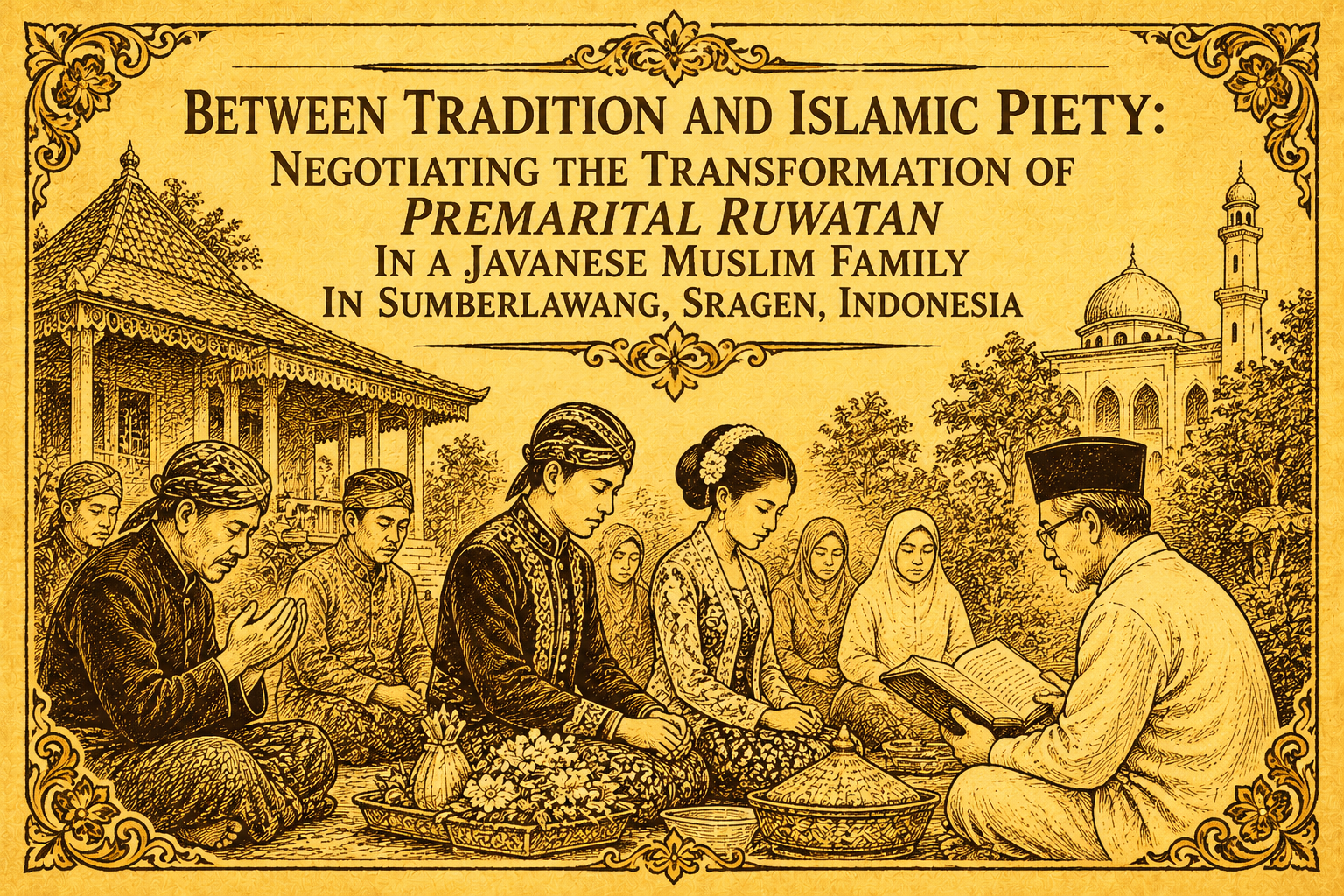
Between Tradition and Islamic Piety: Negotiating the Transformation of Premarital Ruwatan in a Javanese Muslim Family in Sumberlawang, Sragen, Indonesia
DOI:
https://doi.org/10.53088/jih.v6i1sp.3724Keywords:
cultural transformation, Islamic piety, javanese islam, premarital ruwatanAbstract
This study examines the historical transformation of premarital ruwatan in a Javanese Muslim family in Sumberlawang, Sragen, focusing on the negotiation between inherited ritual practices and changing Islamic orientations. Using a qualitative historical approach and a case study design, the research draws on interviews, observation, documentation, and relevant literature. The sources were examined through heuristic collection, source criticism, interpretation, and historiographical reconstruction, supported by triangulation. The findings show that the ritual has undergone selective changes rather than complete abandonment. Its association with sukerta, intergenerational inheritance, premarital timing, and the pursuit of safety remains, while Murwakala performances, mantras, offerings, and other ritual elements have been simplified or replaced with Qur’anic recitation, Yasin, tahlil, khataman, and Islamic prayers. Religious authority has also become more layered through the involvement of kyai alongside the family elder, who remains active as a traditional ruwatan guide. This study contributes to the historiography of Javanese Islam by showing how continuity and change unfold within a family tradition across generations, with Islamization operating through negotiation, reinterpretation, and selective adaptation rather than the wholesale disappearance of Javanese ritual heritage.
REFERENCES
Alfaruq, A. (2026a). Wawancara dengan Pelaku Ruwatan. Wawancara Pribadi.
Alfaruq, A. (2026b). Wawancara dengan Sesepuh. Wawancara Pribadi.
Anam, S., Yusuf, Y., & Karim, A. (2025). ISLAMIZATION OF JAVANESE RITUAL: RUWAT SANTRI AS A REFLECTION OF INTERFAITH AND CULTURAL HARMONY IN INDONESIA. Harmoni, 24, 82–105. https://doi.org/10.32488/harmoni.v24i1.847
Backerra, C. (2024). Source criticism for cultural history. Rethinking History, 28(2), 194–216. https://doi.org/10.1080/13642529.2024.2361214
Beatty, A. (1999). Varieties of Javanese Religion: An Anthropological Account. Cambridge University Press.
Chitwattanakorn, T., Chavasirikultol, N., Kerdngern, N., & Joungtrakul, J. (2024). การตรวจสอบแบบสามเส้าด้านนักวิจัย: กลยุทธ์เพื่อสร้างความเชื่อถือได้ในงานวิจัยเชิงคุณภาพ. 18(3).
Hardiansyah, B., Iriyadi, D., & Gufron, I. A. (2022). Akulturasi Islam pada budaya Ruwatan Rumah di Cikidi Hilir Banten. Satwika : Kajian Ilmu Budaya dan Perubahan Sosial, 6(1), 50–61. https://doi.org/10.22219/satwika.v6i1.19755
Hudayana, B. (2022). Identity Shift: from Javanese Islam to Shari’ah-Centric Muslims in the Trah, a kinship-based social organisation. Contemporary Islam, 16(2), 401–426. https://doi.org/10.1007/s11562-022-00487-5
Iswanto, A. (2026). Reciting Manuscript in Ruwatan among Muslims in East Java: Negotiating Pre-Islamic Traditions, Piety, and Cultural Preservation. Studia Islamika, 33(2), 271–302. https://doi.org/10.36712/sdi.v33i2.46580
Jamal Ghofir, & Daffa Yulia Pratama. (2023). Akulturasi Budaya Tradisi Ruwatan Anak Tunggal Dalam Ajaran Islam di Desa Mandirejo Kecamatan Merakurak Kabupaten Tuban. AN-NASHIHA Journal of Broadcasting and Islamic Communication Studies, 3(1), 16–23. https://doi.org/10.55352/an-nashiha.v3i1.301
Kumaidi. (2023). INTERAKSI SOSIAL MAKNA SIMBOLIK TRADISI RUWATAN MASYARAKAT JAWA. Jurnal Kajian Islam Al Kamal, 3, 119–126. https://ejournal.unesa.ac.id/index.php/paradigma/article/view/33606/30036
Maulana, M. L., & Ngazizah, I. F. (2024). Praktik Tradisi Ruwatan Murwokolo di Kaliori Rembang: Sinergi Antara Kepercayaan Lokal dan Nilai-Nilai Syariah. QULUBANA: Jurnal Manajemen Dakwah, 5(2), 350–367. https://doi.org/10.54396/qlb.v5i2.1588
Mtisi, S. (2022). The Qualitative Case Study Research Strategy as Applied on a Rural Enterprise Development Doctoral Research Project. International Journal of Qualitative Methods, 21, 16094069221145848. https://doi.org/10.1177/16094069221145849
Musonnif, A. (2024). Integrasi Mitos Dan Religi: (Mitologi Jawa dan Religi Islam dalam Ritual Ruwatan Pernikahan oleh Masyarakat Desa Jombok Ngoro Jombang Jawa Timur). Kontemplasi: Jurnal Ilmu-Ilmu Ushuluddin, 12(1), 147–163. https://doi.org/10.21274/kontem.2024.12.1.147-163
Nisa’u, F. I., & Widianto, A. A. (2024). Kiai, Religious Authority, and Dynamics of Ngumbah Keris Tradition in Java, Indonesia. Fikri: Jurnal Kajian Agama, Sosial dan Budaya, 2(9).
Nurhidin, E., & Badruzaman, A. (2022). Ruwat Islami: Islamic dialectics and culture in Java, Indonesia. IBDA` : Jurnal Kajian Islam dan Budaya, 20(2), 249–265. https://doi.org/10.24090/ibda.v20i2.6011
Ricklefs, M. C. (2014). Rediscovering Islam in Javanese History. Studia Islamika, 21(3), 397–418. https://doi.org/10.15408/sdi.v21i3.1216
Sayono, J. (2021). LANGKAH-LANGKAH HEURISTIK DALAM METODE SEJARAH DI ERA DIGITAL. Sejarah dan Budaya: Jurnal Sejarah, Budaya, dan Pengajarannya, 15(2503–1147), 250. https://doi.org/10.17977/um021v15i22021p369
Vivek, R., Nanthagopan, Y., & Piriyatharshan, S. (2023). Beyond methodology: Theoretical foundations of triangulation in qualitative and multi-method research: A literature review. Scientific Studios on Social and Political Psychology, 29(2), 53–62. https://doi.org/10.61727/sssppj/2.2023.53
Wijayanto, M. H., Suparta, I. M., & Setyani, T. I. (2025). Tracing the transformation of the ruwatan rituals in Java from the fifteenth to the twenty-first century. Wacana, 26(3), 537–555. https://doi.org/10.17510/wacana.v26i3.1849
Woodward, M. (1989). Islam in Java_ normative piety and mysticism in the Sultanate of Yogyakarta - Arizona State University.
Downloads
Published
How to Cite
Issue
Section
License
Copyright (c) 2026 Abdullah Alfaruq, Muhammad Zakky, Moh. Ashif Fuadi

This work is licensed under a Creative Commons Attribution-ShareAlike 4.0 International License.
Authors who publish with this journal agree to the following terms:
The author(s) retain copyright and grant the journal the right of first publication with the work simultaneously licensed under a CC BY-SA 4.0 license that allows others to remix, adapt, and build upon the work even for commercial purposes, as long as they credit the author(s) and license their new creations under the identical terms.
License details: https://creativecommons.org/licenses/by-sa/4.0/