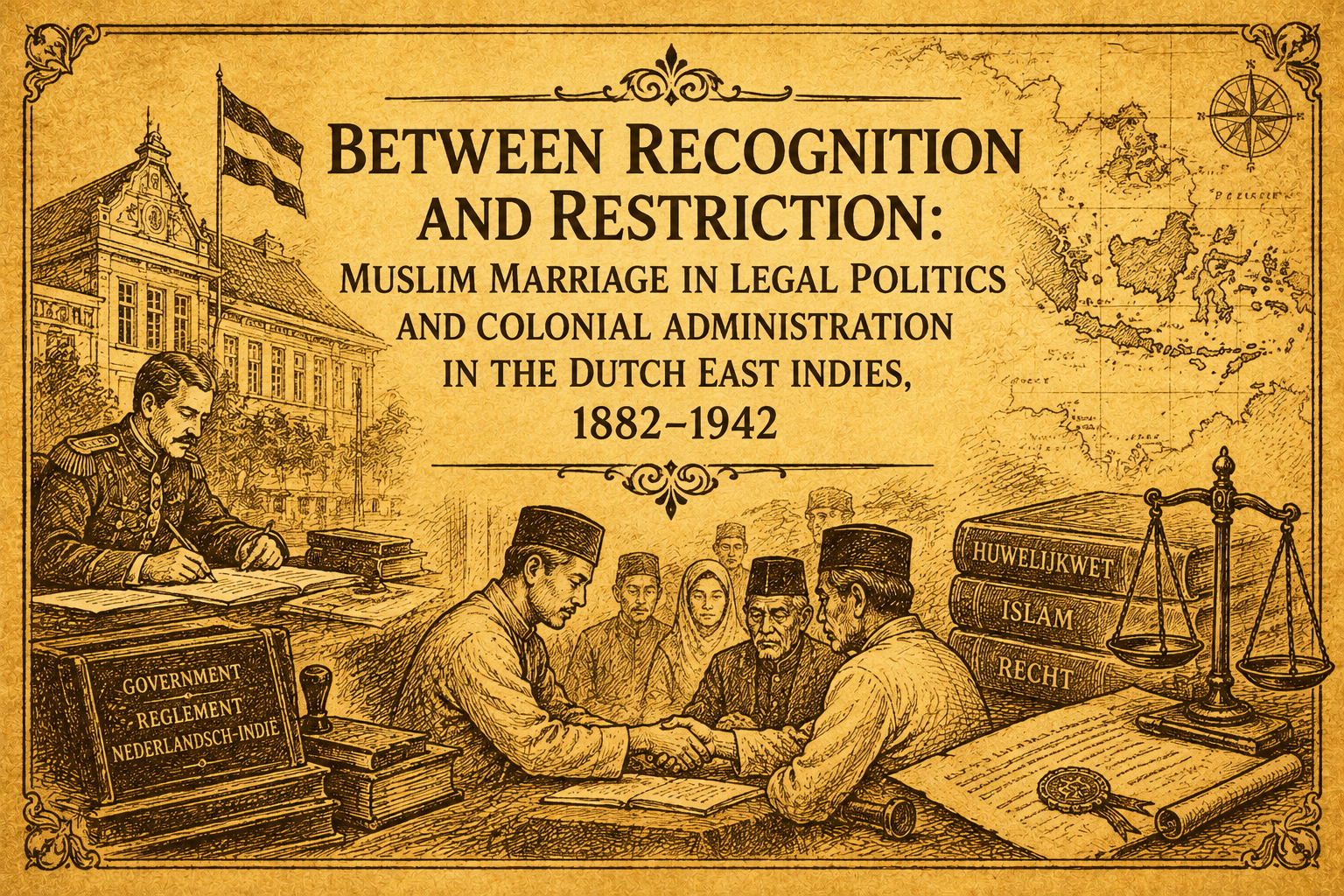
Between Recognition and Restriction: Muslim Marriage in Legal Politics and Colonial Administration in the Dutch East Indies, 1882–1942
DOI:
https://doi.org/10.53088/jih.v6i1sp.3717Keywords:
dutch east indies, legal history, legal politics, muslim marriageAbstract
This article examines the changes in the position of Muslim marriage in the legal politics and administration of the Dutch colonial in the Dutch East Indies in 1882–1942. The research problem departs from colonial policies that did not completely abolish the practice of Islamic marriage law, but gradually incorporated it into the institutional and administrative structure of the government. This study aims to analyze the changes in the legal position of Muslim marriage, the relationship between institutional recognition and administrative supervision, and the interaction between Islamic law, customary law, and colonial law. The research gap lies in the unintegrated discussion of the institutionalization of religious courts since 1882, the administrative arrangement of marriage in 1895–1933, and the change in jurisdiction in 1937 as a series of colonial legal politics. This research uses historical methods through heuristic stages, source criticism, interpretation, and historiography. The main sources include the various Staatsblads that regulated religious courts, marriage, divorce, and the authority of Islamic legal institutions in the period. The results of the study show that colonial politics towards Muslim marriage formed a pattern that can be termed as "controlled recognition". Recognition of Islamic legal institutions and practices took place simultaneously with the standardization of administration, supervision of religious officials, and restrictions on the authority of religious courts. Thus, colonial legal pluralism did not take place in an equal position, but rather in a hierarchical legal structure. These findings show that the history of Muslim marriage was part of the negotiation process between Islamic law, society, and colonial power.
REFERENCES
Ali, M. (2016). Islam and colonialism: Becoming modern in Indonesia and Malaya. Edinburgh University Press.
Arif, M. (2025). Modernisasi hukum perkawinan Islam di Indonesia: Respons ulama atas rancangan Ordonansi Perkawinan era Hindia-Belanda. El-Faqih: Jurnal Pemikiran dan Hukum Islam, 11(1), 108–123. doi: 10.58401/faqih.v11i1.2052
Cammack, M. E., & Feener, R. M. (2012). The Islamic legal system in Indonesia. Pacific Rim Law & Policy Journal, 21(1), 13–32.
Fauzi, M. L. (2019). Registering Muslim marriages: Penghulu, modin, and the struggles for influence. Al-Jami’ah: Journal of Islamic Studies, 57(2), 397–424. doi: 10.14421/ajis.2019.572.397-424
Halim, F. A. (2013). Contestation of the oath procedure in colonial Indonesia’s Islamic court. Indonesia and the Malay World, 41(119), 14–28. doi: 10.1080/13639811.2012.750098
Hariri, A., & Babussalam, B. (2024). Legal pluralism: Concept, theoretical dialectics, and its existence in Indonesia. Walisongo Law Review, 6(2), 146–170. doi: 10.21580/walrev.2024.6.2.25566
Hisyam, M. (2000). Islam and Dutch colonial administration: The case of Panghulu in Java. Studia Islamika, 7(1). doi: 10.15408/sdi.v7i1.717
Islamy, A. (2020). Dinamika historis otoritas hak kepenghuluan nikah di Indonesia. Islamitsch Familierecht Journal, 1(1), 1–22. doi: 10.32923/ifj.v1i01.1472
Mas’ud, M. (2018). The application of Islamic law at the colonial age and its implication for the Indonesian religious justice system. Journal of Islamicate Studies, 1(2). doi: 10.32506/jois.v1i2.459
Muttaqin, E. Z., & Zaini, A. (2020). Preserving Dutch colonial hegemony through incorporated Islamic matrimonial system in the Netherlands East Indies. Ijtihad: Jurnal Wacana Hukum Islam dan Kemanusiaan, 20(1), 97–114. doi: 10.18326/ijtihad.v20i1.97-114
Pebrianto, R., Asasriwarni, & Matondang, I. (2022). The contribution of L.W.C. Van Den Berg’s thoughts in Dutch colonial legal politics on the development of religious courts in Indonesia. AJIS: Academic Journal of Islamic Studies, 7(1), 45–56. doi: 10.29240/ajis.v7i1.3779
Pristiwiyanto. (2014). Staatsblad 1882 Nomor 152 tonggak sejarah berdirinya Pengadilan Agama. Fikroh: Jurnal Pemikiran dan Pendidikan Islam, 8(1), 1–19. doi: 10.37812/fikroh.v8i1.19
Rifqi, M. J. (2021). The superiority of customary law over Islamic law on the existence of inheritance: Reflections on Snouck Hurgronje’s reception theory. Millah: Journal of Religious Studies, 21(1), 217–252. doi: 10.20885/millah.vol21.iss1.art8
Staatsblad van Nederlandsch-Indië. (1820). Staatsblad van Nederlandsch-Indië 1820 No. 22.
Staatsblad van Nederlandsch-Indië. (1835). Staatsblad van Nederlandsch-Indië 1835 No. 58.
Staatsblad van Nederlandsch-Indië. (1882). Staatsblad van Nederlandsch-Indië 1882 No. 152.
Staatsblad van Nederlandsch-Indië. (1895). Staatsblad van Nederlandsch-Indië 1895 No. 198.
Staatsblad van Nederlandsch-Indië. (1929). Staatsblad van Nederlandsch-Indië 1929 No. 348.
Staatsblad van Nederlandsch-Indië. (1931). Staatsblad van Nederlandsch-Indië 1931 No. 467.
Staatsblad van Nederlandsch-Indië. (1932). Staatsblad van Nederlandsch-Indië 1932 No. 482.
Staatsblad van Nederlandsch-Indië. (1933). Staatsblad van Nederlandsch-Indië 1933 No. 98.
Staatsblad van Nederlandsch-Indië. (1937a). Staatsblad van Nederlandsch-Indië 1937 No. 116.
Staatsblad van Nederlandsch-Indië. (1937b). Staatsblad van Nederlandsch-Indië 1937 No. 638.
Staatsblad van Nederlandsch-Indië. (1937c). Staatsblad van Nederlandsch-Indië 1937 No. 639.
Zaini, A., Ridho, M. Z., Muttaqin, E. Z., & Yussof, H. B. (2025). Adaptation of Islamic law in the Dutch colonial era: Fiqh al-aqalliyyāt, Maqasid Al-Shariah, and its legacy for modern Indonesian Islamic legal institutions. Jurnal Ilmiah Al-Syir’ah, 23(2), 265–278. doi: 10.30984/jis.v23i2.2758
Downloads
Published
How to Cite
Issue
Section
License
Copyright (c) 2026 Wahyu Setiawan, Diyo Prabowo

This work is licensed under a Creative Commons Attribution-ShareAlike 4.0 International License.
Authors who publish with this journal agree to the following terms:
The author(s) retain copyright and grant the journal the right of first publication with the work simultaneously licensed under a CC BY-SA 4.0 license that allows others to remix, adapt, and build upon the work even for commercial purposes, as long as they credit the author(s) and license their new creations under the identical terms.
License details: https://creativecommons.org/licenses/by-sa/4.0/