Pengembangan e-repository UIN Salatiga
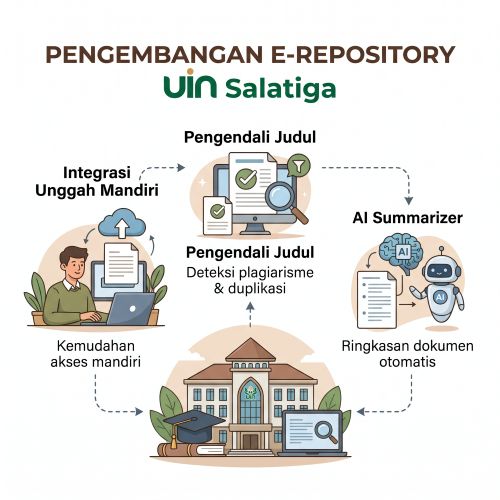
Integrasi unggah mandiri, pengendali judul, dan ai summarizer
DOI:
https://doi.org/10.53088/librarium.v4i1.3812Keywords:
E-repository, perancangan, ai summarize, pengembangan repository, Institutional Repository, Self-Archiving, Title Control, System DevelopmentAbstract
The management of scientific works in the UIN Salatiga Library repository faces several problems, including limited access, barriers in the archiving workflow, a lack of library staff, and difficulties for users in quickly reviewing document content. This study designed and developed a repository, SmartLibrary, by integrating self-archiving, title control, and AI summarisation features. The system was developed using the Design Science Research (DSR) method, which includes problem identification, system architecture connected to campus authentication, workflow demonstration, and functionality evaluation. Data analysis was carried out using Black Box Testing with nine structured scenarios covering operational validity and input error handling, which showed a 100% success rate. The results indicate that the integrated features—self-archiving, title control, and the restricted AI summarizer—function as intended. This system simplifies library administrative procedures for archiving scientific works and helps the UIN Salatiga academic community detect potential duplication of research titles early.
References
Authors Alliance. (2025, Oktober 29). Open? When Site Restrictions and Clauses Undermine Open Access. Authors Alliance. https://www.authorsalliance.org/2025/10/29/open-when-site-restrictions-and-clauses-undermine-open-access/
Committee on Publication Ethics. (2023). Authorship and AI tools (COPE Position Statements). Committee on Publication Ethics. https://publicationethics.org/guidance/cope-position/authorship-and-ai-tools
Green, A. (2025). U.S. Institutional Repositories Respond to AI: Perspectives on Policy and Technical Measures, Labor Impact, and Engagement Metrics. Journal of Library Administration, 65(8), 891–921.
Guidance for generative AI in education and research. (2023). Dalam Guidance for generative AI in education and research. UNESCO. https://doi.org/10.54675/ewzm9535
Harmon, I., & Maistrovskaya, M. (2020). Chapter 3 Integrating Publishers’ Policies and Institutional Repository Workflows. Dalam S. C. Finlay (Ed.), The complete guide to institutional repositories. ALA Editions. https://www.alastore.ala.org/IRguide
Hevner, A. R., March, S. T., Park, J., & Ram, S. (2004). DESIGN SCIENCE IN INFORMATION SYSTEMS RESEARCH 1. Dalam Design Science in IS Research MIS Quarterly (Vol. 28, Nomor 1, hlm. 75).
Jácome Viera, M. F., Carrera Mora, G. N., & Reinoso Naranjo, E. M. (2026). Inteligencia artificial generativa y escritura académica: Desafíos éticos, autoría e integridad científica en la educación superior. Una revisión integrativa sistematizada. Ciencia Digital, 10(3), 222–237. https://doi.org/10.33262/cienciadigital.v10i3.3750
Kamala Ni Made Lila Sri, & Wijayanti, L. (2024). Tinjauan Penerapan Kebijakan Open Access Institutional Repository dalam Pencegahan Plagiarisme | Kamala | Anuva: Jurnal Kajian Budaya, Perpustakaan, dan Informasi. Anuva: Jurnal Kajian Budaya, Perpustakaan, dan Informasi, 8(4), 627–642. https://ejournal2.undip.ac.id/index.php/anuva/article/view/18815
Liang, Y., Zhang, J., Chen, J., Wu, J., Shen, H., & Liang, W. (2026). Generative large language models and academic integrity: Ethical risks, detection challenges, and Governance in the age of AI. Ethics & Behavior, 36(7), 523–541. https://doi.org/10.1080/10508422.2025.2608754
Lynch, C. A. (2003). Institutional Repositories: Essential Infrastructure For Scholarship In The Digital Age. portal: Libraries and the Academy, 3(2), 327–336. https://doi.org/10.1353/PLA.2003.0039
Myers, G. J., Sandler, C., & Badgett, T. (2012). The art of software testing (3rd ed). John Wiley & Sons.
Nonaka, I., & Takeuchi, H. (1996). The knowledge-creating company: How Japanese companies create the dynamics of innovation. Long Range Planning, 29(4), 592. https://doi.org/10.1016/0024-6301(96)81509-3
Oliha, F. O., & Usiobaifo, A. R. (2024). Building academic integrity and scholarly reputation: An emphasis on institutional repositories. Benin Journal of Physical Sciences, 1(1), 148–165. https://publications.bjps.org.ng/sites/default/files/2024-07/BJPS%20Paper%2011.pdf
Peraturan Menteri Pendidikan, Kebudayaan, Riset, dan Teknologi Republik Indonesia Nomor 39 Tahun 2021 tentang Integritas Akademik dalam Menghasilkan Karya Ilmiah, Tahun 2021 Nomor 1363 Berita Negara Republik Indonesia (2021). https://peraturan.go.id/id/permendikbudristek-no-39-tahun-2021
Puspita, D., Roisah, K., & Nanda Lestari, S. (2024). Open Access Institutional Repository in the Digital Era: Preventing or Increasing Plagiarism? Yustisia Jurnal Hukum, 13(2), 168–188. https://doi.org/10.20961/yustisia
Sunandar, D., & Muiz, A. (2025). Thesis Title Similarity Detection System Using Levenshtein Distance and Cosine Similarity. bit-Tech, 8(1), 1131–1139. https://doi.org/10.32877/BT.V8I1.2864
Viera, M. F. J., Mora, G. N. C., & Naranjo, E. M. R. (2026). Generative artificial intelligence and academic writing: Ethical challenges, authorship, and scientific integrity in higher education. A systematized integrative review. Ciencia Digital, 10(3), 222–237. https://doi.org/10.33262/cienciadigital.v10i3.3750
Downloads
Published
How to Cite
Issue
Section
License
Copyright (c) 2026 Sunu Fikri Raharjo, Rio Vindar Prakoso

This work is licensed under a Creative Commons Attribution-ShareAlike 4.0 International License.
Authors retain copyright and grant the journal the right of first publication with the work simultaneously licensed under a Creative Commons Attribution-ShareAlike 4.0 International License. In line with the license, authors are allowed to share and adapt the material. In addition, the material must be given appropriate credit, provided with a link to the license, and indicated if changes were made. If authors remix, transform, or build upon the material, they must distribute their contributions under the same license as the original.
License details: https://creativecommons.org/licenses/by-sa/4.0/