Kesiapan Literasi Digital Mahasiswa dalam Menghadapi Disinformasi Digital
DOI:
https://doi.org/10.53088/librarium.v3i2.3647Keywords:
Digital Literacy, Disinformasi, Mahasiswa Perguruan TinggiAbstract
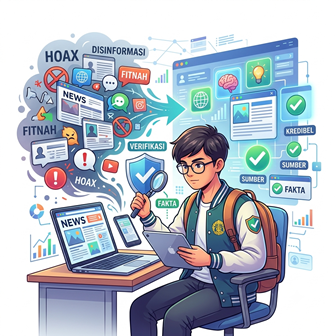
Digital disinformation had become a challenge in higher education information environments because students were active users of various digital sources and platforms. This study aimed to analyse the digital literacy readiness of IAIN Langsa students in dealing with digital disinformation based on information evaluation, digital technology use, and responsibility in digital spaces. This study employed a descriptive quantitative approach involving 118 IAIN Langsa students as respondents. Data were collected through a questionnaire consisting of 15 items representing the three research aspects. The data were analysed descriptively using mean scores, standard deviations, and score categorization. The results showed that students' digital literacy readiness was categorized as high, with an overall mean score of 3.94. Responsibility in digital spaces obtained the highest score (4.25), followed by digital technology use (3.93), while digital information evaluation obtained the lowest score (3.64). The ability to evaluate source credibility emerged as the relatively weakest aspect. The students had a strong foundation of digital literacy readiness, but strengthening information credibility evaluation was needed to enhance their resilience to disinformation. Higher education institutions and academic libraries were recommended to develop practice-based digital literacy programs focusing on information verification and source evaluation.
References
Al Zou’Bi, R. M. (2022). The impact of media and information literacy on students’ acquisition of the skills needed to detect fake news. Journal of Media Literacy Education, 14(2), 58–71. https://doi.org/10.23860/JMLE-2022-14-2-5
Buschman, J. (2024). Fake news as systematically distorted communication: an LIS intervention. Journal of Documentation, 80(1), 203–217. https://doi.org/10.1108/JD-03-2023-0043
Chomintra, M. (2024). Critical race digital literacy rubric for assessing mis/disinformation literacy instruction lesson plans. The Journal of Academic Librarianship, 50(3), 102868. https://doi.org/10.1016/j.acalib.2024.102868
Creswell, J. W., & Creswell, D. J. (2018). Research design: qualitative, quantitative, and mixed methods approaches (5th ed). SAGE Publications.
Dalal, H. A., Taylor, A., & Whitfield, S. (2025). Assessing students’ information literacy: attitudes and perceptions of college students across generations. College & Research Libraries, 86(2), 255–274. https://doi.org/10.5860/crl.86.2.255
Griesbaum, J., Dreisiebner, S., Michel, A., Tappenbeck, I., & Wittich, A. (2025). Information literacy and artificial intelligence: A library and information science perspective on effects, research questions, challenges and opportunities. In Griesbaum, S. Dreisiebner, A. Michel, Tappenbeck, & A. Wittich (Eds.), Information Literacy in an AI-Driven World: 9th European Conference (pp. 3–13). Springer Nature Switzerland. https://doi.org/10.1007/978-3-032-17272-3_1
Hidayat, T., Sari, I., & Noviani, D. (2025). Pengaruh literasi digital terhadap kemampuan berpikir kritis peserta didik di era society 5.0. Jurnal Multidisiplin West Science, 04(08), 1404–1415. https://doi.org/10.58812/jmws.v4i08.2589
Hoque, M. M. (2022). Making a video documentary on fake news and disinformation in Bangladesh: critical reflections and learning. Advances in Journalism and Communication, 10(02), 136–148. https://doi.org/10.4236/ajc.2022.102010
Kirschner, P. A., & De Bruyckere, P. (2017). The myths of the digital native and the multitasker. Teaching and Teacher Education, 67, 135–142. https://doi.org/10.1016/j.tate.2017.06.001
Lo, L. S. (2024). Evaluating AI literacy in academic libraries: a survey study with a focus on U.S. Employees. College & Research Libraries, 85(5), 635–668. https://doi.org/10.5860/crl.85.5.635
Montesi, M., Bornstein, B. Á., Puig, N. B., Ochando, M. B., & Díez, A. S. (2025). AILIS 1.0: A new framework to measure AI literacy in library and information science (LIS). The Journal of Academic Librarianship, 51(5), 103118. https://doi.org/10.1016/j.acalib.2025.103118
Mukhtarullah, M., & Agniya, U. (2025). Peran perpustakaan dalam Literasi digital mahasiswa: studi kasus IAIN Langsa. Literatify : Trends in Library Developments, 6(2), 248–262. https://doi.org/10.24252/literatify.v6i2.60262
Orhan, A. (2023). Fake news detection on social media: the predictive role of university students’ critical thinking dispositions and new media literacy. Smart Learning Environments, 10(1), 29. https://doi.org/10.1186/s40561-023-00248-8
Pool, C. R. (1997). A new digital literacy: A conversation with Paul Gilster 55(3) 6–11. Educational Leadership. https://www.learntechlib.org/p/83481/
Prabowo, T. T., Sitthiworachart, J., & Lo, C. K. (2024). Demographic analysis of information literacy self-efficacy among library and information science students in Indonesia. Library & Information Science Research, 46(1), 101281. https://doi.org/10.1016/j.lisr.2024.101281
Prensky, M. (2001). Digital natives, digital immigrants part 1. On the horizon: The International Journal of Learning Futures, 9(5), 1–6. https://doi.org/10.1108/10748120110424816
Raju, J. (2020). Future LIS education and evolving global competency requirements for the digital information environment: an epistemological overview. Journal of Education for Library and Information Science, 61(3), 342–356. https://doi.org/10.3138/jelis.61.3.2019-0088
Sonni, A. F., Mau, M., Akbar, M., & Putri, V. C. C. (2025). AI and digital literacy: Impact on information resilience in Indonesian society. Journalism and Media, 6(3), 100. https://doi.org/10.3390/journalmedia6030100
Sugiyono. (2017). Metode penelitian kuantitatif, kualitatif dan R&D. Alfabeta.
Sun, H., Yuan, C., Qian, Q., He, S., & Luo, Q. (2022). Digital resilience among individuals in school education settings: A concept analysis based on a scoping review. Frontiers in Psychiatry, Volume 13-858515. https://www.frontiersin.org/journals/psychiatry/articles/10.3389/fpsyt.2022.858515
The Association of College and Research Libraries. (2016). Framework for information literacy for higher education. http://www.ala.org/acrl/files/issues/infolit/framework.pdf.
UNESCO. (2023). Guidance for generative AI in education and research. In Guidance for generative AI in education and research. UNESCO. https://doi.org/10.54675/ewzm9535
UNESCO Institute for Information Technologies in Education. (2011). Digital literacy in education: A policy brief. https://unesdoc.unesco.org/ark:/48223/pf0000214485.locale=en
Vamanu, I., & Zak, E. (2022). Information source and content: articulating two key concepts for information evaluation. Information and Learning Science, 123(1–2), 65–79. https://doi.org/10.1108/ILS-09-2021-0084
Vuorikari, R., Kluzer, S., & Punie, Y. (2022). DigComp 2.2 - The digital competence framework for citizens - With new examples of knowledge, skills and attitudes. Publications Office of the European Union. https://doi.org/10.2760/115376
Willenborg, A., & Detmering, R. (2025). ‘I don’t think librarians can save us’: the material conditions of information literacy instruction in the misinformation age. College & Research Libraries, 86(4), 535–553. https://doi.org/10.5860/crl.86.4.535
Ziv, N., & Bene, E. (2022). Preparing college students for a digital age: A survey of instructional approaches to spotting sisinformation. College & Research Libraries, 83(6), 905–925. https://doi.org/10.5860/crl.83.6.905
Downloads
Published
How to Cite
Issue
Section
License
Copyright (c) 2026 Millatina Mukhtarullah, Ayu Anora

This work is licensed under a Creative Commons Attribution-ShareAlike 4.0 International License.
Authors retain copyright and grant the journal the right of first publication with the work simultaneously licensed under a Creative Commons Attribution-ShareAlike 4.0 International License. In line with the license, authors are allowed to share and adapt the material. In addition, the material must be given appropriate credit, provided with a link to the license, and indicated if changes were made. If authors remix, transform, or build upon the material, they must distribute their contributions under the same license as the original.
License details: https://creativecommons.org/licenses/by-sa/4.0/