Peran Pengorganisasian Program Literasi Berbasis Masyarakat untuk Mendukung Pencapaian Sustainable Development Goals (SDGs)
DOI:
https://doi.org/10.53088/librarium.v3i2.3617Keywords:
Pengorganisasian; Literasi Berbasis Masyarakat; SDGs, Organizing, Community-based Literacy, SDGsAbstract
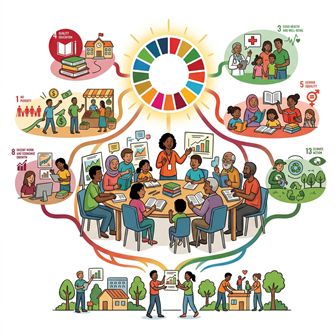
The sustainability of community-based literacy programs is strongly influenced by the effectiveness of organizational management, particularly the implementation of the organizing function. This study aims to analyze the role of the organizing function in sustaining community-based literacy programs at Rumah Pintar Punggur Cerdas, Kubu Raya Regency, and its contribution to the achievement of the Sustainable Development Goals (SDGs), particularly SDG 4 (Quality Education), SDG 10 (Reduced Inequalities), and SDG 17 (Partnerships for the Goals). The study employed a qualitative approach using a case study design. Informants were selected through purposive sampling, while data were collected through in-depth interviews, observations, and document analysis. Data were analyzed using an interactive model consisting of data reduction, data display, and conclusion drawing and verification. The findings reveal that a clear division of responsibilities, a formal organizational structure, delegated authority, and continuous volunteer capacity development constitute the primary factors supporting the sustainability of the literacy program. Nevertheless, the limited number of permanent volunteers, reliance on internship students, and inadequate learning facilities remain significant challenges that require attention. The study concludes that the organizing function serves as a fundamental pillar in establishing sustainable governance for community-based literacy programs while strengthening the contribution of community organizations to improving the quality of education, expanding equitable access to literacy services for all members of society, and fostering collaborative partnerships to support the achievement of the Sustainable Development Goals.
References
Atmasari, Y., Merdiana, A. R., & Mutia, F. (2024). The Role Of Community Reading Parks (TBM) In Literacy Improvment: A Literature Study. BIBLIOTIKA : Jurnal Kajian Perpustakaan Dan Informasi, 8(1), 1. https://doi.org/10.17977/um008v8i12024p1-15
Baporikar, N. (2025). Hierarchy in Organizational Design as a Strategy to Build Resilience: In J. C. D. Rouco & P. C. N. Figueiredo (Eds.), Advances in Logistics, Operations, and Management Science (pp. 77–104). IGI Global. https://doi.org/10.4018/979-8-3693-8809-9.ch003
Costa, D. P., De Souza, D. B., De Souza, M. P., Medeiros, H. D. S., & Biavatti, E. H. Z. S. (2024, July 26). Resource-based insight applies to supply chains in high-impact journals. VI Seven International Multidisciplinary Congress. VI Seven International Multidisciplinary Congress. https://doi.org/10.56238/sevenVImulti2024-097
Creswell, J. W. (2023). Research design: Qualitative, quantitative, and mixed methods approaches (Sixth edition, international student edition). Sage.
Cunha, E. P. (2021). Henri Fayol na encruzilhada da terceira via: Organização da grande corporação e conflito social na forja do ideário fayolista. Revista Eletrônica de Ciência Administrativa, 20(2), 233–261. https://doi.org/10.21529/RECADM.2021008
Dana Pratama, R., Raji, A., Lubis, H. U., & Suyatna, H. (2021). Pemberdayaan Masyarakat Melalui Program Rumah Literasi Kreatif di Kabupaten Kutai Kartanegara. Journal of Social Development Studies, 2(2), 30–42. https://doi.org/10.22146/jsds.1915
Demirkol, M. (2023). An Examining the Relationships between Organizational Structure, Organizational Commitment and Organizational Support in Teachers Through Structural Equation Modeling. International Online Journal of Educational Sciences, 15(4). https://doi.org/10.15345/iojes.2023.04.004
Faizah, A. N., Nurkomariyah, R., Dwiky Denova, Moh. A., & Mas’odi, M. (2025). Peran Literasi Dalam Pembangunan Nasional. Jurnal Pengabdian Masyarakat (ABDIRA), 5(3), 286–292. https://doi.org/10.31004/abdira.v5i3.759
Fathoni*, M. I. A., Fitri, A., & Cindarbumi, F. (2025). Escalation of Literacy at Elementary School Level with AR-Based Learning Media to Realize SDGs in Ngablak Village: Eskalasi Literasi di Tingkat Sekolah Dasar dengan Media Pembelajaran Berbasis AR untuk Mewujudkan SDGs di Desa Ngablak. Dinamisia : Jurnal Pengabdian Kepada Masyarakat, 9(6), 1740–1751. https://doi.org/10.31849/w6cn5707
Gutterman, A. (2023). Organizational Structure. SSRN Electronic Journal. https://doi.org/10.2139/ssrn.4545832
Hughes, A. (2023). Gateways to…literacy: A collaborative effort. Marshall Journal of Medicine, 9(3). https://doi.org/10.33470/2379-9536.1417
Hutahaean, D. S. E., Sinaga, E. C., Mendrofa, G. K. H., Sipangkar, M. J. B., & Khairani, R. (2024). Identifikasi Problematika Pendidikan Di Sekolah Dasar MIS Modern Az-Zakky. Jurnal Yudistira : Publikasi Riset Ilmu Pendidikan Dan Bahasa, 2(3), 160–169. https://doi.org/10.61132/yudistira.v2i3.890
Mendybayev, B., & Perizat, B. (2022). Application of Social Network Analysis and Mintzberg Classification to Assess the Imbalances in Organizational Structure: Case of Kazakhstan Ministry of Ecology, Geology and Natural Resources. 2022 International Conference on Smart Information Systems and Technologies (SIST), 1–6. https://doi.org/10.1109/SIST54437.2022.9945721
Miles, M. B., Huberman, A. M., & Saldana, J. (2024). Qualitative Data Analysis. SAGE Publications. https://books.google.co.id/ books?id=3CNrUbTu6CsC.
Miliyana, M., Metroyadi, M., Suhaimi, S., & 3Master of Education Administration, Universitas Lambung Mangkurat, Banjarmasin 70123, Indonesia. (2022). Literacy Development Management in Schools. International Journal of Social Science And Human Research, 05. https://doi.org/10.47191/ijsshr/v5-i12-10
Mohamed, S. A. B., & Nordin, M. N. (2025). Teaching Strategies Of Abraham Maslow’s Hierarchy Of Needs Theory In Special Education. Special Education [SE], 3(1), e0040. https://doi.org/10.59055/se.v3i1.40
Nagizade, P. (2024). Strategies for creating a positive supportive environment at school. Scientific Works, 91(1), 251–254. https://doi.org/10.69682/azrt.2024.91(1).251-254
Novrita, J., Elizarni, Oktavia, R., & Sari, T. Y. (2025). Making ‘Taman Baca’ Sustainable”, lessons learned from community-based non-formal education in Aceh, Indonesia. International Journal of Educational Development, 113, 103186. https://doi.org/10.1016/j.ijedudev.2024.103186
Prayogo, A. (2022). Peran Taman Bacaan Masyarakat Dalam Meningkatkan Budaya Literasi. Jurnal Imam Bonjo: Kajian Ilmu Informasi Dan Perpustakaan, 6(2), 107–119. https://doi.org/10.15548/jib.v6i2.235
Ramadani, N., Febrianti, & Rachman, I. F. (2024). Optimalisasi Literasi Digital oleh Pemerintah untuk Mendukung Agenda SDGs Goals-17: Partnership for The Goals. Semantik : Jurnal Riset Ilmu Pendidikan, Bahasa Dan Budaya, 2(2), 218–229. https://doi.org/10.61132/semantik.v2i2.630
Robbins, S. P., & Coulter, M. K. (with Randel, A.). (2021). Management (15E, global edition ed.). Pearson.
Saputra, W. E. (2020). Pengaruh Pengorganisasian Dan Koordinasi Terhadap Kinerja Pegawai Pada Kementerian Agama Kabupaten Ogan Komering Ulu Timur Timur. Jurnal Ilmiah Edunomika, 4(02). https://doi.org/10.29040/jie.v4i02.1234
Sumargo, B. (2020). Teknik sampling. UNJ Press.
Supriadi, R., Danugiri, D., & Marlina, R. (2023). Peran Pengelolaan Taman Bacaan Masyarakat(TBM) Budi Luhur dalam Upaya Peningkatan Minat Baca Masyarakat di Kecamatan Tempuran Kabupaten Karawang. JoCE (Journal of Community Education), 2(2), 27–31. https://doi.org/10.35706/joce.v2i2.4535
Wu, Z., & Y. Choi, T. (2022). Contingency theory and the information processing view. Edward Elgar Publishing. https://doi.org/10.4337/9781839104503.00023
Yunus, S., & Ramayanti, I. (2026). Evaluasi Strategis: Analisis Kapasitas Jumlah Pembaca dan Koleksi Buku Taman Bacaan Masyarakat (TBM) di Indonesia. ASPIRASI : Publikasi Hasil Pengabdian Dan Kegiatan Masyarakat, 4(4), 83–93. https://doi.org/10.61132/aspirasi.v4i4.2841
Downloads
Published
How to Cite
Issue
Section
License
Copyright (c) 2026 Sahidi, Sri Wahyuni

This work is licensed under a Creative Commons Attribution-ShareAlike 4.0 International License.
Authors retain copyright and grant the journal the right of first publication with the work simultaneously licensed under a Creative Commons Attribution-ShareAlike 4.0 International License. In line with the license, authors are allowed to share and adapt the material. In addition, the material must be given appropriate credit, provided with a link to the license, and indicated if changes were made. If authors remix, transform, or build upon the material, they must distribute their contributions under the same license as the original.
License details: https://creativecommons.org/licenses/by-sa/4.0/