Societal Altmetrics Impact of Research Publication on Academia and ResearchGate: Scientometric Citation Analysis
DOI:
https://doi.org/10.53088/librarium.v3i2.3578Keywords:
Social Impact, Research Publication, Social websites, Scientometric, Altmetrics, Citation, Academia, ResearchGate, research visibility, Research articles, research output, Impact factors, Index.Abstract
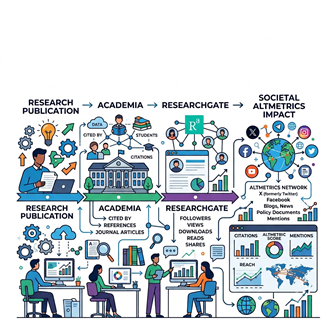
Social websites serve as a unique, quick, and sometimes early indicator of research visibility that supplements conventional citation measures, according to a comparative scientometric examination of the societal impact of research articles on social websites (typically evaluated using Altmetrics). Social impact gauges instant attention, engagement, and reach among the public, policymakers, and other researchers, whereas academic influence is determined by long-term citations. Research and Review articles typically reach a wider audience in the professional or public sphere, as evidenced by their better social impact (higher Altmetrics scores) compared to original research publications. In this study, researchers examined the various social effects of research platforms, i.e., Academia and ResearchGate. This study's goal is to investigate how websites could provide these services for handling research data and integrating all networks to provide the data. The significance of distributing and preserving research data and daily citations is monitored by their respective geographical areas, views of citation, styles of access, utilisation of time, Countries, Cities, Universities, and the title of the research. Jobs, reading pages, and search engines are used for downloads and views. Many users use ResearchGate for the dissemination of their research works. But compared to other research websites, the Academia webpage is very important and user-friendly, keeping user data in a multidimensional view and tracing out their details at any time. The researchers advised everyone to benefit from Academia and keep their research data in Academia for more advantages in future endeavours. It shows that most of the users are going to use the Academia website to keep their research records in Academia in future because of the continuous development and enhancements in this search engine. ResearchGate is a free and well-established platform for researchers; everyone can benefit from it.
References
Thelwall M, Haustein S, Larivière V, Sugimoto CR (2013): Do Altmetrics work? Twitter and ten other social web services. Plosone. 2013; 8(5): 64841. https://doi.org/10.1371/journal.pone.0064841.
Wouters P, Costas R. Users, narcissism and control: tracking the impact of scholarly publications in the 21st century. 2012; 847-57. https://www.researchgate.net/publication/268271559. Cited 12 Feb 2026.
Neylon C, Wu S. Level metrics and the evolution of scientific impact. Plos Biology. 2009;7(11):e1000242.
Priem J, Piwowar HA, Hemminger BM. Altmetrics in the wild: Using social media to explore scholarly impact. arXiv preprint arXiv:1203.4745. 2012.
Haustein S, Peters I, Sugimoto CR, Thelwall M, Larivière V. Tweeting biomedicine: An analysis of tweets and citations in the biomedical literature. Journal of the Association for Information Science and Technology. 2014;65(4):656-69.
Bar-Ilan J, Haustein S, Peters I, Priem J, Shema H, Terliesner J. Beyond citations: Scholars’ visibility on the social Web. arXiv preprint arXiv:1205.5611. 2012.
Costas R, Zahedi Z, Wouters P. Do “Altmetrics” correlate with citations? Extensive comparison of Altmetrics indicators with citations from a multidisciplinary perspective. Journal of the Association for Information Science and Technology. 2015;66(10):2003-19.
Maflahi N, Thelwall M. When are readership counts as useful as citation counts? Scopus versus Mendeley for LIS journals. Journal of the Association for Information Science and Technology. 2016;67(1):191-9.
Bornmann L. Do Altmetrics point to the broader impact of research? An overview of the benefits and disadvantages of Altmetrics. Journal of Informetric. 2014; 8(4):895-903.
Holmberg K. Classifying Altmetrics by Level of Impact. In ISSI 2015. Retrieved February 20, 2019, from https://pdfs.semanticscholar.org/49df/91ccd2579b4b34 5c135a6ff751bf-39f7ee86.pdf
Junping Q, Houqiang Y. Stratifying Altmetrics Indicators Based on Impact Generation Model. In Proceedings of ISSI 2015 Istanbul: 15th International Society of Scientometrics and Informetrics Conference. 2015.
Colledge L. Snowball metrics recipe book. Amsterdam: Snowball Metrics Program Partners, 110. 2014. Retrieved February 20, 2019, from https://www. snowballmetrics.com/wp-content/uploads/snowball-recipe-book_HR.pdf
Holmberg K, Bowman T D, Didegah F. The meaning of impact is broken down into three Altmetrics. Scientometrics. 2015;103(3):1123-44.
Cristina Garcia-Villar. A Critical review on Altmetrics: Can we measure the Social Impact Factor? Educational Review,2021;12(92).
Galickas D, Flaherty GT. Is there an association between article citations and Altmetrics in travel medicine research? Journal of Travel Medicine. 2021;28(8):taab115.
Lemke S, Mazarakis A, Peters I. Conjoint analysis of researchers’ hidden preferences for bibliometrics, altmetrics, and usage metrics. Journal of the Association for Information Science and Technology. 2021;72(6):777-92.
Shenavar A, Doulani A. Review of Iranian Journal Articles Indexed in Web of Science Based on Altmetric Indicators in Scientific Social Media. Webology. 2020;17(1).
Taberner R (2018) Altmetrics: beyond the impact factor. Actas Dermosifiliogr (Engl Ed) 109:95–97. https://doi.org/10.1016/j.ad.2018.01.002 Cited 13 Feb 2026.
Williams AJ, Peck L, Ekins S (2017) The new alchemy: online networking, data sharing and research activity distribution tools for scientists. F1000Res 6:1315. https://doi.org/10.12688/f1000research.12185.1 Cited 13 Feb 2026.
Academia.edu website. https://www.academia.edu/. Cited 13 Feb 2026.
ResearchGate website. https://www.researchgate.net/. Cited 13 Feb 2026.
Twitter website. https://twitter.com. Cited 13 Feb 2026.
Facebook website. https://www.facebook.com/. Cited 13 Feb 2026.
YouTube website. https://www.youtube.com. Cited 13 Feb 2026.
SlideShare website. https://es.slideshare.net/. Cited 13 Feb 2026.
LinkedIn website. https://es.linkedin.com/. Cited 13 Feb 2026.
Li X, Thelwall M, Giustini D (2012) Validating online reference managers for scholarly impact measurement. Scientometrics 91:461–471. https://doi.org/10.1007/s11192-011-0580-x Cited 13 Feb 2026.
Zotero website. https://www.zotero.org/. Cited 13 Feb 2026.
Mendeley website. https://www.mendeley.com. Cited 13 Feb 2026.
Researchblogging website. http://researchblogging.org/news/. Cited 13 Feb 2026.
Torres-Salinas D, Cabezas-Clavijo A. Blogs as a new channel of scientific communication. http://eprints.rclis.org/14078/1/Torres-Salinas,_Daniel_y_Cabezas-Clavijo,_Alvaro._Los_blogs_como_nuevo_medio_de_comunicacion_cientifica.pdf. Cited 13 Feb 2026.
Directory of Open Access Journals (DOAJ) https://doaj.org/ Cited 13 Feb 2026.
Figshare website. https://figshare.com/. Cited 13 Feb 2026.
Crotty D (2017) Altmetrics. Eur Heart J 38:2647-2648. Cited 13 Feb 2026. https://doi.org/10.1093/eurheartj/ehx447
Faculty 1000 website. https://f1000.com/. Cited 13 Feb 2026.
Wikipedia website. https://es.wikipedia.org/wiki/Wikipedia:Portada. Cited 13 Feb 2026.
Reddit website. https://www.reddit.com/. Cited 13 Feb 2026.
PlumX website. https://plumanalytics.com/learn/about-metrics/. Cited 13 Feb 2026.
"CiteULike Cited 12 Feb 2026.
https://web.archive.org/web/20190328231005/http://www.citeulike.org/
Li, Teng (8 September 2006). "CiteULike: Your online library of scientific literature, and more..." iMechanica. Cited 13 Feb 2026.
Zlatić, Vinko; Ghoshal, Gourab; Caldarelli, Guido (25 September 2009). "Hypergraph topological quantities for tagged social networks". Physical Review E. 80 (3) 036118: 036118. arXiv:0905.0976. Bibcode:2009PhRvE..80c6118Z. doi:10.1103/PhysRevE.80.036118. ISSN 1539-3755. PMID 19905191. S2CID 90024.
Good, B. M.; Tennis, J. T.; Wilkinson, M. D. (2009). "Social tagging in the life sciences: Characterizing a new metadata resource for bioinformatics". BMC Bioinformatics. 10 313. doi:10.1186/1471-2105-10 313.
Hull, Duncan; Pettifer, Steve R.; Kell, Douglas B. (October 2008). McEntyre, Johanna (ed.). "Defrosting the digital library: Bibliographic tools for the next generation web". PLOS Computational Biology. 4 (10) e1000204: Cited on 13 Feb 2026. DOI:10.1371/journal.pcbi.1000204. ISSN 1553-734X.
"Frequently Asked Questions". CiteULike. Who is behind CiteULike?. Cited on 13 Feb 2026.
Gallagher, Fergus (19 February 2019). Cited on 13 Feb 2026.
Wiki: https://citeulike.org/en-in/ Wikipedia, https://en.wikipedia.org/wiki/CiteULike Cited on 13 Feb 2026.
Gabour L Lovei: Citation Statistics and Scientometric: Writing and publishing Scientific papers: 2021. Data available on ResearchGate. Cited on 16 Feb 2026. DOI: 10.11647/OBP.0235.03
Garfield E. Citation indexes to science: a new dimension in documenta-tion through association of ideas. Science 1955;122:108–11.https://doi.org/10.1126/science.122.3159.108.
Aksnes DW, Langfeldt L, Wouters P. Citations, citation indicators, andresearch quality: an overview of basic concepts and theories. SAGEOpen 2019;9:1–17. https://doi.org/10.1177/2158244019829575.
Zijlstra H, McCullough R. CiteScore:A new metric to help you track journal performance and make decisions. Elsevier. Cited on 17 Feb 2026.
Gasparyan AY, Yessirkepov M, Duisenova A, Trukhachev VI, Kostyukova EI, Kitas GD. Researcher and author impact metrics:Variety, value, and context. J Korean Med Sci. 2018;33:e139. doi: 10.3346/jkms.2018.33.e139.
Bar-Ilan J. Which h-index?—A comparison of WoS, Scopus and Google Scholar. Scientometrics. 2008;74:257–71.
Kaliyadan F, Ashique KT. Citation indices. J Skin Sex Transm Dis. 2020;2:2–4.
Downloads
Published
How to Cite
Issue
Section
License
Copyright (c) 2026 V Thangavel

This work is licensed under a Creative Commons Attribution-ShareAlike 4.0 International License.
Authors retain copyright and grant the journal the right of first publication with the work simultaneously licensed under a Creative Commons Attribution-ShareAlike 4.0 International License. In line with the license, authors are allowed to share and adapt the material. In addition, the material must be given appropriate credit, provided with a link to the license, and indicated if changes were made. If authors remix, transform, or build upon the material, they must distribute their contributions under the same license as the original.
License details: https://creativecommons.org/licenses/by-sa/4.0/