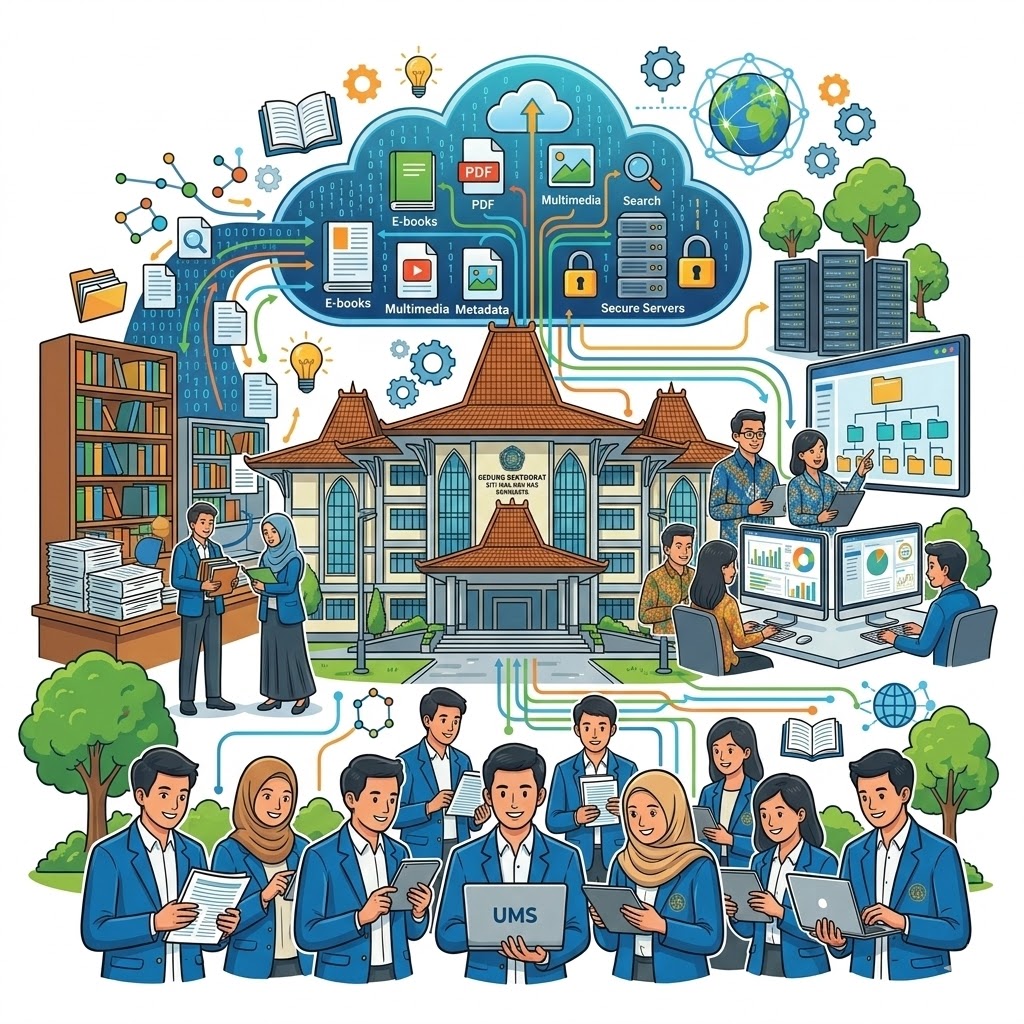
Strategi Pengelolaan dan Transformasi Repository Digital di Perpustakaan Universitas Muhammadiyah Surakarta (UMS)
DOI:
https://doi.org/10.53088/librarium.v3i1.1966Keywords:
digital repository, Eprints, library strategy, open access, UMSAbstract
This study aimed to analyze the management strategies and digital transformation of the institutional repository at the Library of Universitas Muhammadiyah Surakarta (UMS). The research focused on how repository management is systematically implemented and how the transformation evolved from a manual system to a self-upload digital platform. A qualitative approach was used, employing in-depth interviews, direct observation, and documentation as data collection techniques. The data were analyzed using the interactive model of Miles and Huberman. The findings revealed that UMS Library has undergone a gradual transformation in managing its repository, starting from collecting academic works in CD format to implementing a self-upload system using Eprints. The management strategies included technical infrastructure, institutional policy support, and collaboration with the university’s IT team. Although the repository has positively impacted operational efficiency and academic visibility, it still faces challenges such as storage limitations and the need for ongoing system updates. The study concludes that the success of repository transformation is influenced by the synergy between institutional policy, technology adoption, and human resource involvement.
References
Creswell, J. W. (2013). Qualitative inquiry and research design: Choosing among five approaches (third edition). SAGE.
Novianto, A. Q. (2020). Repositori Institusi dan Kontribusinya dalam Meningkatkan Reputasi Universitas (Studi di UPT Perpustakaan Universitas Negeri Malang). Buletin Perpustakaan, 3(2), Article 2.
Ratna Patria. (2023, Oktober 14). Apa itu Repository? Pengertian, Manfaat & Daftarnya. DomaiNesia. https://www.domainesia.com/berita/repository-adalah/
Rifai, A. (2015). Partial Least Square-Structural Equation Modeling (PLS-SEM) untuk mengukur ekspektasi penggunaan repositori lembaga: Pilot studi di UIN Syarif Hidayatullah Jakarta. Al Maktabah, 14(1), Article 1. https://doi.org/10.15408/almaktabah.v14i1.2251
Rifauddin, M., & Halida, A. N. (2018). Persepsi Mahasiswa Terhadap Sistem Unggah Mandiri dan Akses ETD Repositori di Perpustakaan UGM Yogyakarta. Pustabiblia: Journal of Library and Information Science, 2(2), Article 2. https://doi.org/10.18326/pustabiblia.v2i2.195-211
Setiyono, J., & M, M. (2019). Persepsi Pemustaka terhadap Pengembangan Institutional Repository di Perpustakaan Isi Surakarta. Publication Library and Information Science, 3(1), 20. https://doi.org/10.24269/pls.v3i1.1576
Supriati, E., & Murbayanto, H. (2022). Improving library services through digital-based promotion. Indonesian Journal of Academic Librarianship, 6(1), Article 1.
Suwanto, S. A. (2017). Manajemen Layanan Repository Perguruan Tinggi. Lentera Pustaka: Jurnal Kajian Ilmu Perpustakaan, Informasi dan Kearsipan, 3(2), 165–176.
Syahrial, M. (2018). Rancang Bangun Repositori Institusi Perpustakaan Berbasis Web. InfoTekJar : Jurnal Nasional Informatika dan Teknologi Jaringan, 2(2), Article 2. https://doi.org/10.30743/infotekjar.v2i2.172
Zulfirman, R. (2022). Implemetasi Metode Outdoor Learning dalam Peningkatan Hasil Belajar Siswa pada Mata Pelajaran Pendidikan Agama Islam di MAN 1 Medan. Jurnal Penelitian, 3(2).
Downloads
Published
How to Cite
Issue
Section
License
Copyright (c) 2026 Naoura Naoura, Prawidya Yogi Hapsari, Yusril Akbar Izzul Khaq, Muhammad Idris Sofwan Hadi

This work is licensed under a Creative Commons Attribution-ShareAlike 4.0 International License.
Authors retain copyright and grant the journal the right of first publication with the work simultaneously licensed under a Creative Commons Attribution-ShareAlike 4.0 International License. In line with the license, authors are allowed to share and adapt the material. In addition, the material must be given appropriate credit, provided with a link to the license, and indicated if changes were made. If authors remix, transform, or build upon the material, they must distribute their contributions under the same license as the original.
License details: https://creativecommons.org/licenses/by-sa/4.0/