Divergent Interpretations of Jihād in West Africa: a Historical Analysis of the Al-Muridiyyah and Boko Haram Movements
DOI:
https://doi.org/10.53088/jih.v6i1.2901Keywords:
jihād, senegal, nigeria, al-muridiyyah, boko haramAbstract
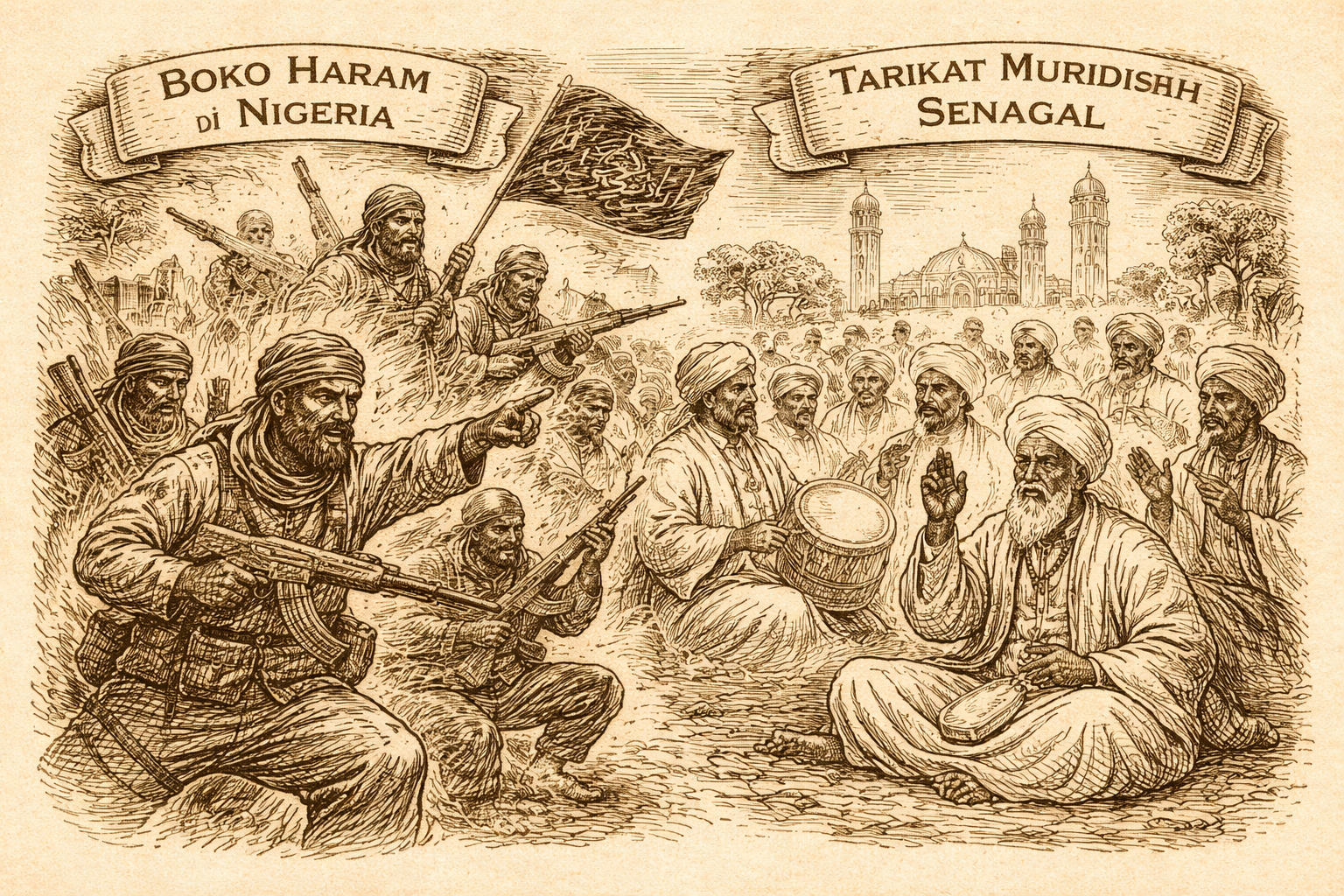
This paper explores the divergent interpretations of jihād in contemporary West Africa through a comparative study of two Islamic movements: Boko Haram in Nigeria and the Al-Muridiyyah order in Senegal. While jihād is often misrepresented in global discourse as synonymous with “holy war,” this concept encompasses a broader range of meanings in Islamic tradition, including ethical self-discipline and spiritual struggle. Nigeria has become one of the most affected countries by Islamist terrorism, with Boko Haram’s violent jihadist ideology causing tens of thousands of deaths, targeting both Muslims and Christians. In contrast, Senegal has remained free from jihadist attacks, despite being a majority-Muslim country. This exceptional stability is attributed largely to the influence of Sufi brotherhoods, particularly the Al-Muridiyyah, which promotes a peaceful, work-centered, and spiritual understanding of jihād, rooted in the teachings of Amadou Bamba (1853-1927), Woerner‑Powell (2025). Through this comparative analysis, the article highlights how religious interpretation, historical context, and sociopolitical factors shape divergent trajectories within Islamic societies, and how localized spiritual traditions can serve as effective cultural buffers against religious extremism.
REFERENCES
Abimbola, Adesoji (2010), The Boko Haram Uprising and Islamic Revivalism in Nigeria, Africa Spectrum, 45(2), 95-108.
Agbiboa, D. E. (2013). No retreat, no surrender: Understanding the religious terrorism of Boko Haram in Nigeria. African Study Monographs, 34(2), 65-84.
Ajala, O. (2018). Formation of insurgent groups: MEND and Boko Haram in Nigeria. Small Wars & Insurgencies, 29(1), 112–130.
Babou, Cheikh Anta (2007), Fighting the Greater Jihad: Amadu Bamba and the Founding of the Muridiyya of Senegal, 1853–1913, Athens: Ohio University Press.
Bamba, Sheikh Ahmadou (2009), Ways unto Heaven (Masalik-ul-Jinan), translated by Abdoul Aziz Mbacke, Atlanta: Institute Islamic Khadimou Rassoul.
Firestone, Reuven (1999), Jihad: The Origin of Holy War in Islam, Oxford & New York: Oxford University Press.
Forest, J. J. F. (2012). Confronting the terrorism of Boko Haram in Nigeria. MacDill Air Force Base: The JSOU Press.
Ghandour, Mahmoud (2002), Jihad in Islam: The Misunderstood Doctrine, New York: Vantage Press.
Glover, John (2007), Sufism and Jihad in Modern Senegal: The Murid Order, Rochester: University of Rochester Press.
Joos, Louis C. D. (1966), Scurtă istorie a Africii Negre, București: Editura Politică.
Kabbani, Shaykh Muhammad Hisham (2010), Jihad: Principles of Leadership in War and Peace, Fenton: Islamic Supreme Council of America.
Kassim, Abdulbasit & Nwankpa, Michael (2018), The Boko Haram Reader: From Nigerian Preachers to the Islamic State, Oxford & New York: Oxford University Press.
Last, Murray (1967), The Sokoto Caliphate, London: Longmans, Green and Co.
MacEachern, S. (2018). Searching for Boko Haram: A history of violence in Central Africa. New York: Oxford University Press.
Mahalli, Jalalu’d Din & Al-Suyuti, Jalalu’d Din (2007), Tafsir Al-Jalalayn, London: Dar Al-Taqwa Ltd.
Murphy, E. Jefferson (1981), Istoria Civilizației Africane, vol. II, translated by Corneliu Rudescu, București: Editura Minerva.
Niasse, Ibrahim (2014), In the Meadow of Tafsir for the Noble Qur’an, translated by Moctar Boubakar, Atlanta: Fayda Books.
Radian, Liana (1966), Senegal, București: Editura Științifică.
Rusin, Cristi (2019), The Ideological Origins of a Terrorist group: Boko Haram. Analele Universității București: Istorie, 68(1-2), 91-115.
Rusin, Cristi (2021), Originile ideologice ale grupării teroriste Boko Haram, București: Editura TopForm.
Rusin, Cristi (2023), Combaterea terorismului ca element de consolidare a relațiilor diplomatice din Africa. Studiu de caz: Boko Haram, Nigeria și Ciad, București: Editura TopForm.
Rusin, Cristi (2024), “Relația dintre Amadou Bamba și administrația colonială franceză din Senegal”, în Oameni, Crize și Soluții în Istorie, ed. Florentina Nițu & Elena Adelina Tudor, București: Editura Universității din București.
Sambe, Bakary (2010), Islam et diplomatie: La politique africaine du Maroc, Paris: Éditions Karthala.
Smith, Mike (2017), Boko Haram: Cea mai sângeroasă grupare teroristă a lumii, translated by Dragoș Zetu, București: Editura Corint.
Solomon, H. (2015). Terrorism and counter-terrorism in Africa: Fighting insurgency from Al Shabaab, Ansar Dine and Boko Haram. London: Palgrave Macmillan.
Ulph, Stephen (2013), Boko Haram: Investigating the Ideological Background to the Rise of an Islamist Militant Organization, McLean: Westminster Institute.
Umar, M. S. (2012). The popular discourses of Salafi radicalism and Salafi counter-radicalism in Nigeria: A case study of Boko Haram. Journal of Religion in Africa, 42(2), 118-144.
Ware, Rudolph; Wright, Zachary & Sayed, Amir (2018), Jihad of the Pen: The Sufi Literature of West Africa, Cairo & New York: The American University in Cairo Press.
Ware, R. (2022). Principled pacifism in Islamic West Africa. In J. Cole (Ed.), Peace movements in Islam: History, religion, and politics (pp. 75–88). London: I.B. Tauris.
Woerner‑Powell, T. (2025). Hierarchy, community, and nonviolence in Senegal: Amadou Bamba’s legacy in contemporary Islamic philosophy. In Pacifism and non‑violence in contemporary Islamic philosophy (pp. 24–53). Cambridge: Cambridge University Press.
Zenn, J., Barkindo, A., & Heras, N. A. (2013). The ideological evolution of Boko Haram in Nigeria: Merging local Salafism and international jihadism. The RUSI Journal, 158(4), 46-53.
Zenn, J. (2014). Nigerian Al-Qa‘edism. Current Trends in Islamist Ideology, 16, 99–117.
- (2003), The Holy Qur’an, translated by Abdullah Yusuf Ali, Ware: Wordsworth Editions Limited.
Downloads
Published
How to Cite
Issue
Section
License
Copyright (c) 2026 Cristi Rusin

This work is licensed under a Creative Commons Attribution-ShareAlike 4.0 International License.
Authors who publish with this journal agree to the following terms:
The author(s) retain copyright and grant the journal the right of first publication with the work simultaneously licensed under a CC BY-SA 4.0 license that allows others to remix, adapt, and build upon the work even for commercial purposes, as long as they credit the author(s) and license their new creations under the identical terms.
License details: https://creativecommons.org/licenses/by-sa/4.0/